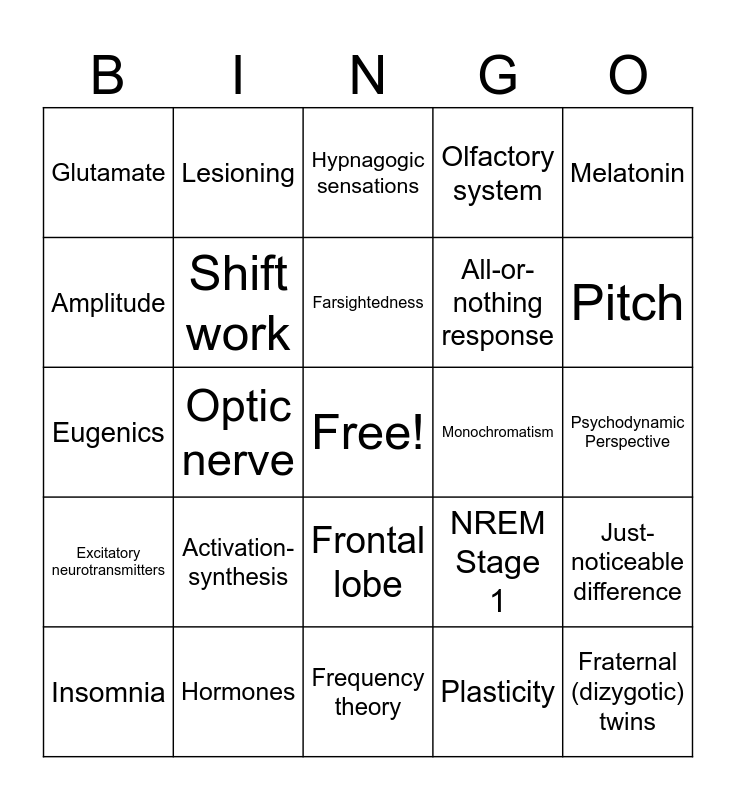
This bingo card has a free space and 173 words: Biological Perspective, Cognitive Perspective, Behavioral Perspective, Humanistic Perspective, Psychodynamic Perspective, Sociocultural Perspective, Evolutionary Perspective, Nature, Nurture, Genetic predisposition, Evolutionary Psychology, Natural selection, Eugenics, Identical (monozygotic) twins, Fraternal (dizygotic) twins, Cerebral cortex, Frontal lobe, Parietal lobe, Temporal lobe, Occipital lobe, Association areas, Motor cortex, Prefrontal cortex, Somatosensory cortex, Corpus callosum, Brainstem, Medulla, Reticular activating system, Cerebellum, Limbic system, Thalamus, Hypothalamus, Hippocampus, Amygdala, Pituitary Gland, Reward center, Central nervous system, Peripheral nervous system, Autonomic nervous system, Sympathetic nervous system, Parasympathetic nervous system, Somatic nervous system, Neurons, Glial Cells, Motor neurons, Sensory neurons, Interneurons, Synapse, Reflex arc, Neural transmission, Threshold, Action potential, All-or-nothing response, Depolarization, Refractory period, Resting Potential, Reuptake, Multiple sclerosis, Myasthenia gravis, Neurotransmitters, Excitatory neurotransmitters, Glutamate, Inhibitory neurotransmitters, GABA, Dopamine, Serotonin, Endorphins, Substance p, Acetylcholine, Hormones, Ghrelin, Leptin, Melatonin, Oxytocin, Adrenaline, Norepinephrine, Plasticity, Epilepsy, Split brain research, Contralateral hemispheric organization, Hemispheric specialization, Linguistic processing, Broca’s area, Broca’s Aphasia, Wernicke’s area, Wernicke’s Aphasia, EEG, Epilepsy, fMRI, Lesioning, Consciousness, Circadian rhythm, Jet lag, Shift work, NREM Stage 1, Hypnagogic sensations, NREM Stage 2, NREM Stage 3, Restoration of resources, REM Sleep, REM Rebound, Activation-synthesis, Consolidation theory, Insomnia, Narcolepsy, REM Sleep Behavior Disorder, Sleep apnea, Somnambulism, Psychoactive drugs, Agonists, Antagonists, Reuptake inhibitors, Stimulants, Depressants, Hallucinogens, Opioids, Tolerance, Addiction, Withdrawal, Sensation, Perception, Transduction, Absolute threshold, Just-noticeable difference, Weber’s Law, Sensory adaptation, Synesthesia, Pupil, Iris, Retina, Photoreceptors, Rods, Cones, Fovea, Blind spot, Optic nerve, Ganglion cells, Lens, Accommodation, Nearsightedness, Farsightedness, Trichromatic theory, Opponent-processing theory, Afterimages, Color vision deficiency, Dichromatism, Monochromatism, Blindsight, Prosopagnosia, Wavelength, Amplitude, Pitch, Pitch perception, Place theory, Frequency theory, Volley theory, Sound localization, Conduction deafness, Sensorineural deafness, Sensory Interaction, Olfactory system, Pheromones, Gustation, Supertasters, Medium tasters, Nontasters, Warm/cold receptors, Pain, Gate control theory, Phantom limb, Vestibular sense, Semicircular canals and Kinesthesis.
⚠ This card has duplicate items: Epilepsy (2)
AP Psych Unit 1 Bingo!! | AP Psych Unit 5 Final Review | AP Psych Unit 3 Final Review | AP Psych Unit 3 Final Review | Module 3: Neural & Hormonal Systems!
Share this URL with your players:
For more control of your online game, create a clone of this card first.
Learn how to conduct a bingo game.
With players vying for a you'll have to call about __ items before someone wins. There's a __% chance that a lucky player would win after calling __ items.
Tip: If you want your game to last longer (on average), add more unique words/images to it.