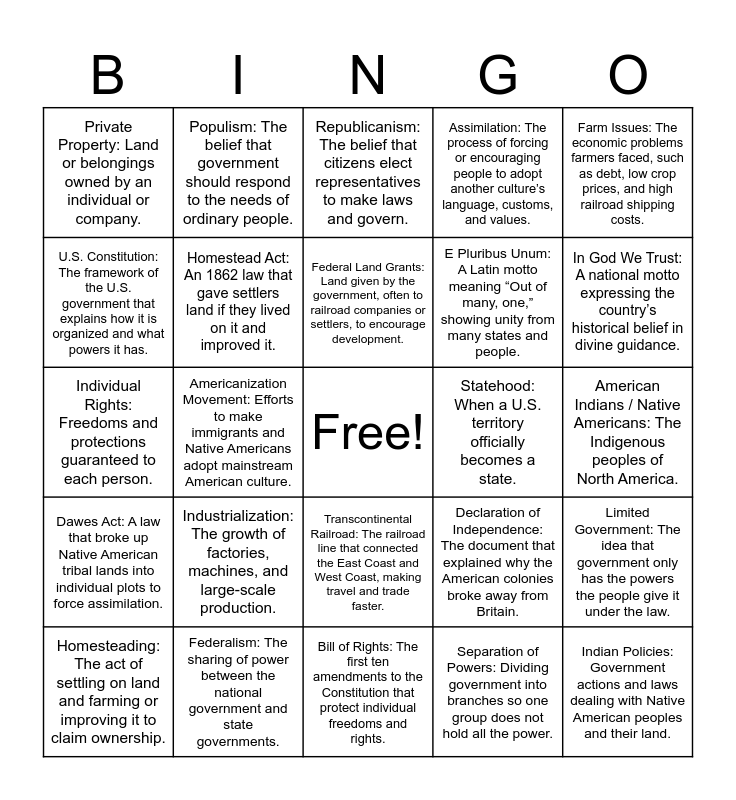
This bingo card has a free space and 39 words: Westward Expansion: The movement of settlers, businesses, and railroads into the western United States., Great Plains: The large central grassland region of the United States where many settlers moved., Frontier: The edge of settled land where people were moving into new territory., Homestead Act: An 1862 law that gave settlers land if they lived on it and improved it., Homesteading: The act of settling on land and farming or improving it to claim ownership., Transcontinental Railroad: The railroad line that connected the East Coast and West Coast, making travel and trade faster., Federal Land Grants: Land given by the government, often to railroad companies or settlers, to encourage development., Cattle Industry: The business of raising, herding, and selling cattle., Farm Issues: The economic problems farmers faced, such as debt, low crop prices, and high railroad shipping costs., Dawes Act: A law that broke up Native American tribal lands into individual plots to force assimilation., Americanization Movement: Efforts to make immigrants and Native Americans adopt mainstream American culture., Assimilation: The process of forcing or encouraging people to adopt another culture’s language, customs, and values., Indian Policies: Government actions and laws dealing with Native American peoples and their land., American Indians / Native Americans: The Indigenous peoples of North America., Statehood: When a U.S. territory officially becomes a state., Industrialization: The growth of factories, machines, and large-scale production., Railroads: Train routes that transported people and goods across long distances., Private Property: Land or belongings owned by an individual or company., Rural Society: Communities in the countryside built around farming, ranching, and small towns., Declaration of Independence: The document that explained why the American colonies broke away from Britain., U.S. Constitution: The framework of the U.S. government that explains how it is organized and what powers it has., Bill of Rights: The first ten amendments to the Constitution that protect individual freedoms and rights., E Pluribus Unum: A Latin motto meaning “Out of many, one,” showing unity from many states and people., In God We Trust: A national motto expressing the country’s historical belief in divine guidance., Constitutional Republic: A government where people elect representatives and government power is limited by a constitution., Founding Principles: The basic ideas that shaped American government, such as liberty, equality, and self-government., Liberty: Freedom for people to think, speak, and act without unfair government control., Egalitarianism: The belief that all people are equal and deserve equal rights and opportunities., Individualism: The idea that each person is responsible for their own success and choices., Populism: The belief that government should respond to the needs of ordinary people., Laissez-faire: An economic idea that government should interfere as little as possible in business., Popular Sovereignty: The idea that government gets its power from the people., Republicanism: The belief that citizens elect representatives to make laws and govern., Federalism: The sharing of power between the national government and state governments., Separation of Powers: Dividing government into branches so one group does not hold all the power., Checks and Balances: A system where each branch of government can limit the power of the others., Limited Government: The idea that government only has the powers the people give it under the law., Individual Rights: Freedoms and protections guaranteed to each person. and Patriotism: Pride in and loyalty to one’s country..
American&Westward | 3.1 Forms of Government Vocabulary | History Chapter 5 Bingo | Constitution Bingo | 7 principals
Share this URL with your players:
For more control of your online game, create a clone of this card first.
Learn how to conduct a bingo game.
With players vying for a you'll have to call about __ items before someone wins. There's a __% chance that a lucky player would win after calling __ items.
Tip: If you want your game to last longer (on average), add more unique words/images to it.