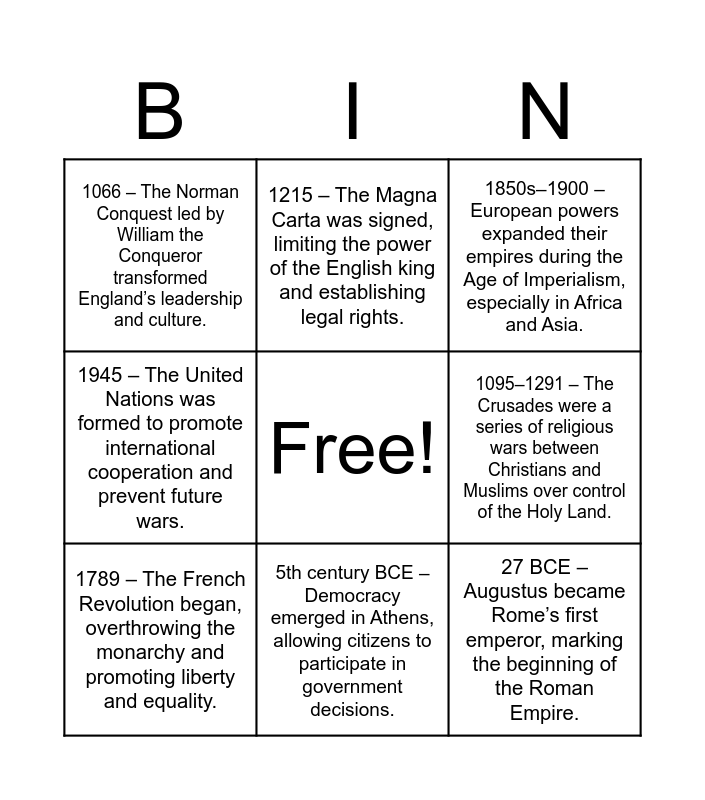
This bingo card has a free space and 25 words: c. 3000 BCE – The first civilisations in Mesopotamia and Egypt developed cities, writing systems, and organised governments., c. 1750 BCE – The Code of Hammurabi was created as one of the earliest written law codes., 5th century BCE – Democracy emerged in Athens, allowing citizens to participate in government decisions., 221 BCE – Qin Shi Huang unified China and established its first centralised imperial government., 27 BCE – Augustus became Rome’s first emperor, marking the beginning of the Roman Empire., 1066 – The Norman Conquest led by William the Conqueror transformed England’s leadership and culture., 1095–1291 – The Crusades were a series of religious wars between Christians and Muslims over control of the Holy Land., 1215 – The Magna Carta was signed, limiting the power of the English king and establishing legal rights., 1347–1351 – The Black Death spread across Europe, killing millions and causing major social and economic changes., c. 1300–1600 – The Renaissance was a period of renewed interest in art, science, and classical learning in Europe., 1517 – Martin Luther began the Reformation by challenging the Catholic Church’s authority., 1492 – Christopher Columbus reached the Americas, leading to European exploration and colonisation., 1607 – The English established Jamestown, their first permanent colony in North America., 1776 – The United States declared independence from Britain, forming a new nation based on democratic ideals., 1789 – The French Revolution began, overthrowing the monarchy and promoting liberty and equality., c. 1760–1840 – The Industrial Revolution transformed production through machines and led to urbanisation., 1807 – Britain abolished the transatlantic slave trade, marking a key step toward ending slavery., 1850s–1900 – European powers expanded their empires during the Age of Imperialism, especially in Africa and Asia., 1901 – Australia became a federation, forming the Commonwealth of Australia., 1914–1918 – World War I was a global conflict that led to the collapse of empires and redrawing of borders., 1917 – The Russian Revolution overthrew the monarchy and led to the rise of a communist government., 1929 – The Great Depression began, causing worldwide economic hardship and unemployment., 1939–1945 – World War II was a global war that reshaped international power and ended with Allied victory., 1945 – The United Nations was formed to promote international cooperation and prevent future wars. and 1947–1991 – The Cold War was a prolonged period of tension between the United States and the Soviet Union without direct large-scale conflict..
Glossary and Terms | Traditional Arts WeekHistory Bingo | Revolutionary War Bingo | test 4 | Social Studies
Share this URL with your players:
For more control of your online game, create a clone of this card first.
Learn how to conduct a bingo game.
With players vying for a you'll have to call about __ items before someone wins. There's a __% chance that a lucky player would win after calling __ items.
Tip: If you want your game to last longer (on average), add more unique words/images to it.