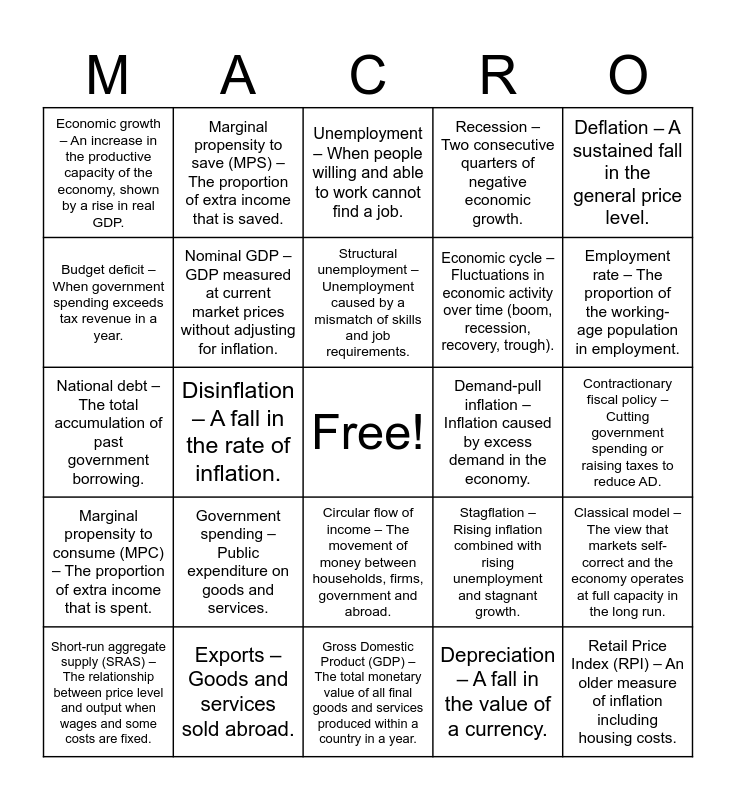
This bingo card has a free space and 57 words: Aggregate demand (AD) – The total demand for goods and services in an economy at a given price level and time., Short-run aggregate supply (SRAS) – The relationship between price level and output when wages and some costs are fixed., Long-run aggregate supply (LRAS) – The maximum productive potential of the economy when all resources are fully employed., Economic growth – An increase in the productive capacity of the economy, shown by a rise in real GDP., Gross Domestic Product (GDP) – The total monetary value of all final goods and services produced within a country in a year., Real GDP – GDP adjusted for inflation., Nominal GDP – GDP measured at current market prices without adjusting for inflation., GDP per capita – GDP divided by the population, indicating average living standards., Economic cycle – Fluctuations in economic activity over time (boom, recession, recovery, trough)., Boom – A period of rapid economic growth and rising incomes., Recession – Two consecutive quarters of negative economic growth., Recovery – The phase after a recession where the economy begins to grow again., Trough – The lowest point in the economic cycle before recovery., Positive output gap – When actual GDP exceeds potential GDP, creating inflationary pressure., Negative output gap – When actual GDP is below potential GDP, creating unemployment., Inflation – A sustained increase in the general price level., Deflation – A sustained fall in the general price level., Disinflation – A fall in the rate of inflation., Consumer Price Index (CPI) – The main measure of inflation based on a basket of goods and services., Retail Price Index (RPI) – An older measure of inflation including housing costs., Demand-pull inflation – Inflation caused by excess demand in the economy., Cost-push inflation – Inflation caused by rising production costs., Stagflation – Rising inflation combined with rising unemployment and stagnant growth., Unemployment – When people willing and able to work cannot find a job., Cyclical unemployment – Unemployment caused by a lack of demand during a recession., Structural unemployment – Unemployment caused by a mismatch of skills and job requirements., Frictional unemployment – Short-term unemployment when people move between jobs., Seasonal unemployment – Unemployment occurring at certain times of the year., Employment rate – The proportion of the working-age population in employment., Productivity – Output per worker or per hour worked., Fiscal policy – Government use of taxation and spending to influence the economy., Monetary policy – Central bank control of interest rates and money supply to influence the economy., Interest rates – The cost of borrowing money or the reward for saving., Expansionary fiscal policy – Increasing government spending or cutting taxes to boost AD., Contractionary fiscal policy – Cutting government spending or raising taxes to reduce AD., Budget deficit – When government spending exceeds tax revenue in a year., Budget surplus – When tax revenue exceeds government spending., National debt – The total accumulation of past government borrowing., Multiplier effect – The process by which an initial change in spending leads to a larger change in GDP., Marginal propensity to consume (MPC) – The proportion of extra income that is spent., Marginal propensity to save (MPS) – The proportion of extra income that is saved., Circular flow of income – The movement of money between households, firms, government and abroad., Injections – Additions to the circular flow (investment, government spending, exports)., Withdrawals (leakages) – Removals from the circular flow (savings, taxes, imports)., Savings – Income not spent on consumption., Investment – Spending on capital goods that increase future production., Government spending – Public expenditure on goods and services., Exports – Goods and services sold abroad., Imports – Goods and services bought from abroad., Exchange rate – The price of one currency in terms of another., Appreciation – A rise in the value of a currency., Depreciation – A fall in the value of a currency., Balance of payments – A record of all financial transactions between a country and the rest of the world., Current account – Part of the balance of payments showing trade in goods/services and income flows., Keynesian model – The view that AD determines output and government intervention is often needed., Classical model – The view that markets self-correct and the economy operates at full capacity in the long run. and Animal spirits – Consumer and business confidence affecting spending and investment decisions..
Macro Bingo | Macro 6 and 7 | Macroeconomics - Economic Measurements | IBS Chapter 1-2 Vocabulary Review | Macro Revision
Share this URL with your players:
For more control of your online game, create a clone of this card first.
Learn how to conduct a bingo game.
With players vying for a you'll have to call about __ items before someone wins. There's a __% chance that a lucky player would win after calling __ items.
Tip: If you want your game to last longer (on average), add more unique words/images to it.