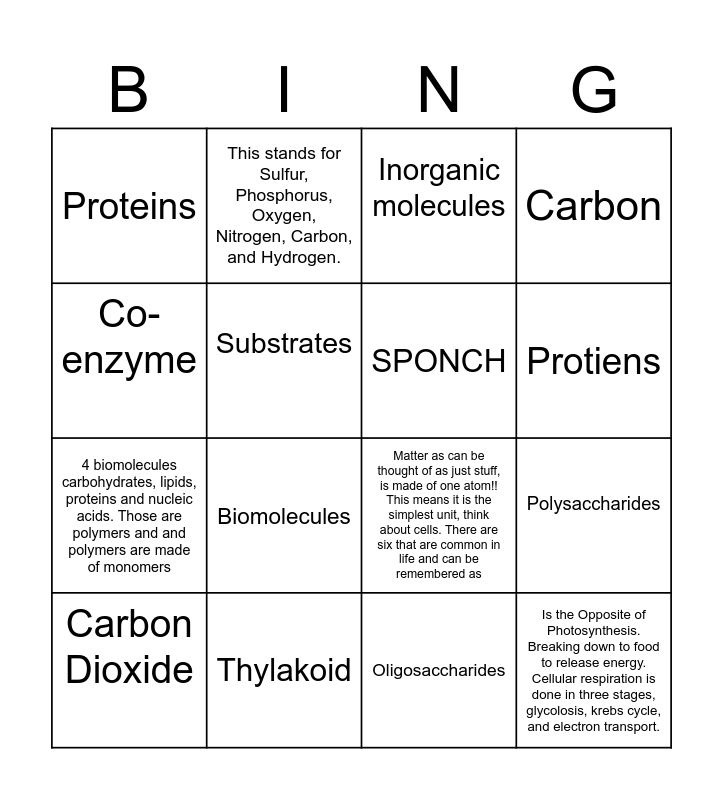
This bingo card has 75 words: Element, This stands for Sulfur, Phosphorus, Oxygen, Nitrogen, Carbon, and Hydrogen., Inorganic molecules, 4 biomolecules carbohydrates, lipids, proteins and nucleic acids. Those are polymers and and polymers are made of monomers, Lipids, Catalyst, Enzyme, This process happens regardless pf if oxygen is present. It involves breaking down sugar to release ATP. The electrons created in this add to the conversion of NAD+ to NADH., Free!, Opposite of Photosynthesis, Thylakoid, NADP, Protiens, Substrates, Amount of energy required to move reactants to products., Polysaccharides, Cellular Respiration Output, Carbon Dioxide, Nucleic acids, Co-enzyme, Element, Matter as can be thought of as just stuff, is made of one atom!! This means it is the simplest unit, think about cells. There are six that are common in life and can be remembered as, SPONCH, This stands for Sulfur, Phosphorus, Oxygen, Nitrogen, Carbon, and Hydrogen., Carbon, Is the superstar of SPONCH. It makes up most living matter. Can have four bonds., Carbon Dioxide, One carbon attached to two oxygen atoms., Water, Two hydrogen atoms attached to an oxygen atom., Organic molecules, Molecules with carbon are organic molecules., Inorganic molecules, Molecules without carbon are inorganic molecules., Biomolecules, 4 biomolecules carbohydrates, lipids, proteins and nucleic acids. Those are polymers and and polymers are made of monomers, Carbohydrates, The simplest carbohydrates are monosaccharides. Known as a source of energy. Also the Cellular Respiration Output, Oligosaccharides, Three to ten sugar molecules., Polysaccharides, Ten plus sugar molecules., Lipids, Are the molecules known for storing energy. Made of long carbon and hydrogen chains. They are saturated and unsaturated. Unsaturated has a double bond., Nucleic acids, Found in the nucleus of the cell. A polymer that is the backbone of DNA, Glycolysis, Proteins, Made of long chains of amino acids, it takes 20 to make a protein., Catalyst, A substance (think thing) that speeds up a reaction. It does so by decreasing the activation energy., Activation energy, Amount of energy required to move reactants to products., Enzyme, Proteins that bind to substrates. Things that affect enzymes are temperature, ph and, Substrates, Molecules acted upon by enzymes. The substrate is then joined or broken, forever being changed by the enzyme., Co-enzyme, Non-protein molecule that activates the enzyme. Adenosine triphosphate also known as ATP and nicotinamide adenine dinucleotide or NAD+ are co-enzymes., ATP, ATP becomes adenosine diphosphate also called ADP., NAD+, NAD+ becomes nicotinamide adenine dinucleotide phosphate NADP., Photosynthesis, Process which takes water, light. And carbon dioxide to convert into energy molecules which are the Cellular Respiration input. Photosynthesis takes place in the chloroplast., Thylakoid, It is in the double membrane. It also contains green pigment called chlorophyll., Calvin Cycle, The light independent reaction is called Calvin cycle. It takes place in the stroma. Uses energy made during light dependent reaction which can be made into sugar to use as food source or to enter cellular respiration., Cellular Respiration, Is the Opposite of Photosynthesis. Breaking down to food to release energy. Cellular respiration is done in three stages, glycolosis, krebs cycle, and electron transport., Glycolysis, This process happens regardless pf if oxygen is present. It involves breaking down sugar to release ATP. The electrons created in this add to the conversion of NAD+ to NADH., Krebs Cycle and When aerobically respiring the broken down sugar enters the mitochondria..
⚠ This card has duplicate items: Element (2), This stands for Sulfur, Phosphorus, Oxygen, Nitrogen, Carbon, and Hydrogen. (2), 4 biomolecules carbohydrates, lipids, proteins and nucleic acids. Those are polymers and and polymers are made of monomers (2), Amount of energy required to move reactants to products. (2), Glycolysis (2)
Chemistry of Life | Chemistry of Life | Cell Respiration Bingo | Photosynthesis & Cellular Respiration | Photosynthesis & Cellular Respiration
Share this URL with your players:
For more control of your online game, create a clone of this card first.
Learn how to conduct a bingo game.
With players vying for a you'll have to call about __ items before someone wins. There's a __% chance that a lucky player would win after calling __ items.
Tip: If you want your game to last longer (on average), add more unique words/images to it.