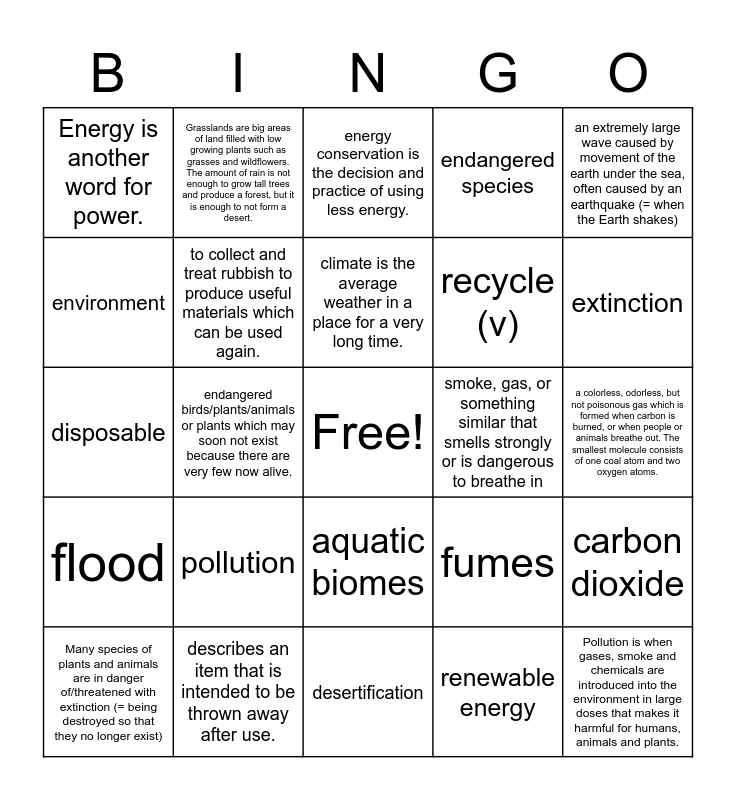
This bingo card has a free space and 89 words: acid rain, acid rain is a rain which contains large amounts of harmful chemicals as a result of burning substances such as coal and oil., aquatic biomes, Marine biomes, freshwater biomes and coral reefs are examples of marine biomes., biodegradable, able to be broken down (=decay) naturally and harmlessly., biodiversity, the variety of life in the world or in a particular area or ecosystem., biome, A biome is a way to describe a large group of similar ecosystems. Biomes have similar weather, rainfall, animals and plants., carbon monoxide, a colorless, odorless, and poisonous gas which is formed by the burning of carbon, especially in the form of car fuel. The smallest molecule consists of one coal atom and one oxygen atom., carbon dioxide, a colorless, odorless, but not poisonous gas which is formed when carbon is burned, or when people or animals breathe out. The smallest molecule consists of one coal atom and two oxygen atoms., climate, climate is the average weather in a place for a very long time., climate change, Climate is the average weather in a place over many years. Climate change is a shift in those average conditions., deforestation, the cutting down of trees in a large area without replacing the trees; the destruction of forests by people., desert, Areas with little or no rainfall, few animals and plants and strong winds are called deserts., desertification, the process by which fertile land becomes desert, typically as a result of drought, deforestation, or inappropriate agriculture., disposable, describes an item that is intended to be thrown away after use., drought, a long period when there is little or no rain., earthquake, a sudden violent movement of the Earth's surface, sometimes causing great damage., endangered species, endangered birds/plants/animals or plants which may soon not exist because there are very few now alive., energy, Energy is another word for power., energy conservation, energy conservation is the decision and practice of using less energy., environment, the air, water and land in or on which people, animals and plants live., extinction, Many species of plants and animals are in danger of/threatened with extinction (= being destroyed so that they no longer exist), flood, a large amount of water covering an area that is usually dry., freshwater biomes =, There are three main types of freshwater biomes: ponds and lakes, streams and rivers, and wetlands., fumes, smoke, gas, or something similar that smells strongly or is dangerous to breathe in, global warming, An increase in the average temperature of the Earth's atmosphere (especially a long-term increase that causes climatic changes), grasslands, Grasslands are big areas of land filled with low growing plants such as grasses and wildflowers. The amount of rain is not enough to grow tall trees and produce a forest, but it is enough to not form a desert., greenhouse effect, Likewise, Earth’s atmosphere traps energy from the Sun. Carbon dioxide and other gases—called greenhouse gases—in the air do this trapping. Without these gases too much heat would go back into space and living things could not survive. However,, Greenpeace, an organization that fights for the protection of the environment., habitat, A habitat is the home of an animal or a plant. Almost every place on Earth —from the hottest desert to the coldest ice pack—is a habitat for some kinds of animals and plants., land biomes, Deserts, grasslands, tundras, tropical rainforests, temperate forests and taigas are examples of land biomes., marine biomes, There are two major aquatic or water biomes, the marine biome and the freshwater biome. The marine biome is primarily made up of the saltwater oceans., natural resources, Materials or substances such as minerals, forests, water, and fertile land that occur in nature and can be used for economic gain., Example: Some natural resources, such as natural gas and fossil fuel, cannot be replaced., oil spill, a word used to describe a situation when oil is accidentally released into the environment by humans. Spilled or leaked oil can contaminate water, making it dangerous for animals and humans who live near the place where the oil spill., The term oil slick often refers to marine oil spills, where oil is released into the ocean or coastal waters., ozone layer, a layer of air high above the Earth, which contains a lot of ozone, and which prevents harmful ultraviolet light from the sun from reaching the Earth., Example: Scientists believe that there is a hole in the ozone layer., pollution, Pollution is when gases, smoke and chemicals are introduced into the environment in large doses that makes it harmful for humans, animals and plants., precipitation, Precipitation is the release of water from the sky. It is a term in meteorology, and includes rain, snow, sleet, dew, frost, and hail., recycle (v), to collect and treat rubbish to produce useful materials which can be used again., renewable energy, a form of energy that can be produced as quickly as it is used because it has a theoretically unlimited supply and is therefore not depleted when used by humans., sustainable development, a development that is causing little or no damage to the environment and therefore able to continue for a long time., tsunami, an extremely large wave caused by movement of the earth under the sea, often caused by an earthquake (= when the Earth shakes), taiga, The Taiga is one of the three main forest biomes. The other two are the temperate forest and the tropical rainforest. The taiga is the driest and coldest of the forest biomes. It is sometimes called the coniferous forest (=barrskog) or the boreal, temperate forest, A temperate forest has four distinct seasons: spring, summer, fall and winter. The trees in such forests have leaves that grow in the spring, are green in the summer and becomes red in the autumn. During the winter, these trees have no leaves at, tropical rainforest, Rainforests are very humid and warm all the year. These forests get lots of rain. Some tropical rainforests have a drier season and a wetter season while other rainforests gets rain every day., tundra and Tundra is a treeless landscape that covers almost 20 percent of Earth's surface. Most tundra is around the Arctic Circle, but there is also tundra near Antarctica and on high mountains. The region is cold, dry, and windy. Snow covers the ground.
Environment | Biomes | Biomes | Forest | Ecosystems and Biomes
Share this URL with your players:
For more control of your online game, create a clone of this card first.
Learn how to conduct a bingo game.
With players vying for a you'll have to call about __ items before someone wins. There's a __% chance that a lucky player would win after calling __ items.
Tip: If you want your game to last longer (on average), add more unique words/images to it.