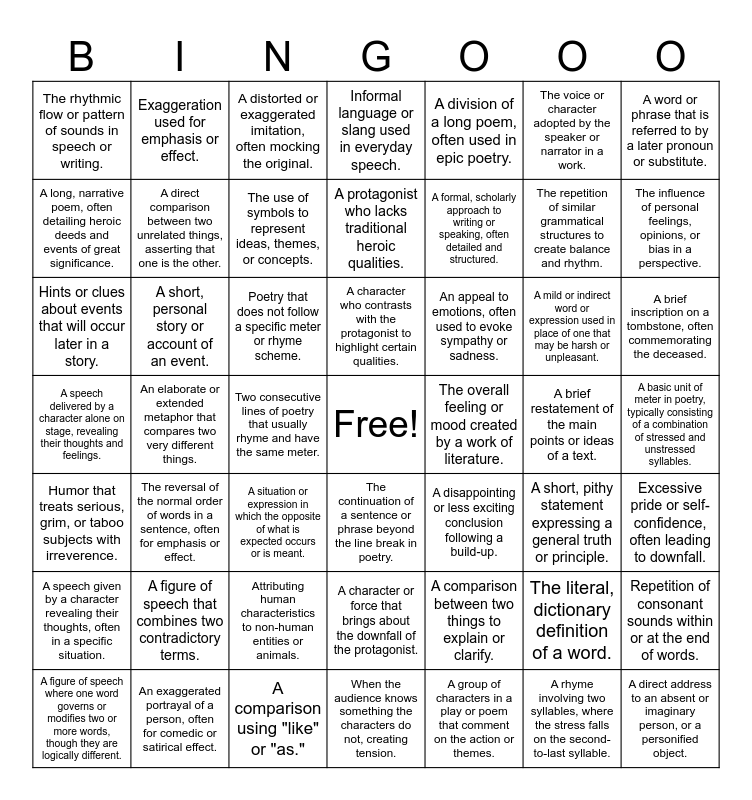
This bingo card has a free space and 97 words: A style focused on concepts, often without direct representation., A narrative poem, often with a song-like quality and a focus on drama or romance., Humor that treats serious, grim, or taboo subjects with irreverence., A formal, scholarly approach to writing or speaking, often detailed and structured., A distinctive way of pronunciation or speech, often linked to regional or cultural identity., Pompous, exaggerated language used to impress others., The study or appreciation of beauty, art, and taste., A form of comedy that mocks or exaggerates its subject matter., A symbolic story where characters or events represent abstract ideas or moral qualities., The repetition of initial consonant sounds in close proximity., A reference to a well-known person, event, or work outside the text., Something that is out of its proper time period., A comparison between two things to explain or clarify., A short, personal story or account of an event., A harsh, discordant mixture of sounds., The rhythmic flow or pattern of sounds in speech or writing., A division of a long poem, often used in epic poetry., An exaggerated portrayal of a person, often for comedic or satirical effect., Emotional release or purification, often experienced through art or tragedy., A group of characters in a play or poem that comment on the action or themes., Crudely written or poorly constructed verse, often with a humorous or mocking tone., When the audience knows something the characters do not, creating tension., A speech given by a character revealing their thoughts, often in a specific situation., A poem or song expressing sorrow, usually for the dead., The continuation of a sentence or phrase beyond the line break in poetry., A long, narrative poem, often detailing heroic deeds and events of great significance., A brief inscription on a tombstone, often commemorating the deceased., A mild or indirect word or expression used in place of one that may be harsh or unpleasant., Pleasant, harmonious sound or rhythm in language., A comedic work with exaggerated, improbable situations and absurd characters., A word or phrase that is referred to by a later pronoun or substitute., Informal language or slang used in everyday speech., A rhyme involving two syllables, where the stress falls on the second-to-last syllable., Attributing human characteristics to non-human entities or animals., An elaborate or extended metaphor that compares two very different things., A character who contrasts with the protagonist to highlight certain qualities., A disappointing or less exciting conclusion following a build-up., The emotional or cultural associations of a word beyond its literal meaning., A basic unit of meter in poetry, typically consisting of a combination of stressed and unstressed syllables., A protagonist who lacks traditional heroic qualities., Repetition of consonant sounds within or at the end of words., Hints or clues about events that will occur later in a story., A short, pithy statement expressing a general truth or principle., Two consecutive lines of poetry that usually rhyme and have the same meter., Poetry that does not follow a specific meter or rhyme scheme., A direct address to an absent or imaginary person, or a personified object., Appropriate behavior or speech, often adhering to established conventions., The use of outdated or old-fashioned words or expressions., A remark made by a character directly to the audience, not intended to be heard by other characters., The choice of words and style of expression in writing or speech., The repetition of vowel sounds within words in close proximity., The overall feeling or mood created by a work of literature., The literal, dictionary definition of a word., A mournful song or poem, typically for the dead., Dissonance – A lack of harmony or agreement, often used in music or poetry for tension., A genre of fiction characterized by mystery, horror, and often supernatural elements., Excessive pride or self-confidence, often leading to downfall., Exaggeration used for emphasis or effect., A narrative technique that reveals a character's inner thoughts and feelings., The reversal of the normal order of words in a sentence, often for emphasis or effect., A situation or expression in which the opposite of what is expected occurs or is meant., An emotional, often exuberant expression of feeling, especially in art or music., A satirical piece of writing that ridicules someone or something., A question asked for effect, not requiring an answer., A short poem expressing personal thoughts and feelings, often musical., The use of humor, irony, or ridicule to criticize or mock societal issues or individuals., A rhyme that ends with a stressed syllable., A comparison using "like" or "as.", A dramatic work characterized by exaggerated emotions and clear distinctions between good and evil., A speech delivered by a character alone on stage, revealing their thoughts and feelings., A direct comparison between two unrelated things, asserting that one is the other., A figure of speech in which something is referred to by something closely related to it., A character or force that brings about the downfall of the protagonist., The presentation of facts or events without personal bias or emotion., Words that imitate the sound they represent., A figure of speech that combines two contradictory terms., A grouped set of lines in a poem, often separated by a space., Stereotypical or universally recognized characters, such as the "mad scientist" or "damsel in distress.", The influence of personal feelings, opinions, or bias in a perspective., A grammatical mood used to express wishes, hypothetical situations, or doubts., A brief restatement of the main points or ideas of a text., The use of symbols to represent ideas, themes, or concepts., A simple story that conveys a moral or lesson., The central idea or message in a work of literature., A statement that contradicts itself but may reveal a deeper truth., The central argument or claim of a piece of writing or research., The repetition of similar grammatical structures to create balance and rhythm., A character trait that leads to the downfall of a protagonist in a tragedy., A humorous imitation of a serious work or style., A literary work that idealizes rural life and nature., A distorted or exaggerated imitation, often mocking the original., A self-evident or obvious truth., An imagined, perfect society or place., An appeal to emotions, often used to evoke sympathy or sadness., The voice or character adopted by the speaker or narrator in a work., A figure of speech where one word governs or modifies two or more words, though they are logically different. and Attributing human qualities to non-human objects or abstract concepts..
poetry | Poetry Vocabulary | Poetry Lingo Bingo | Wonders Unit 2 Week 5 Vocabulary | Poetry and Literary Terms
Share this URL with your players:
For more control of your online game, create a clone of this card first.
Learn how to conduct a bingo game.
With players vying for a you'll have to call about __ items before someone wins. There's a __% chance that a lucky player would win after calling __ items.
Tip: If you want your game to last longer (on average), add more unique words/images to it.