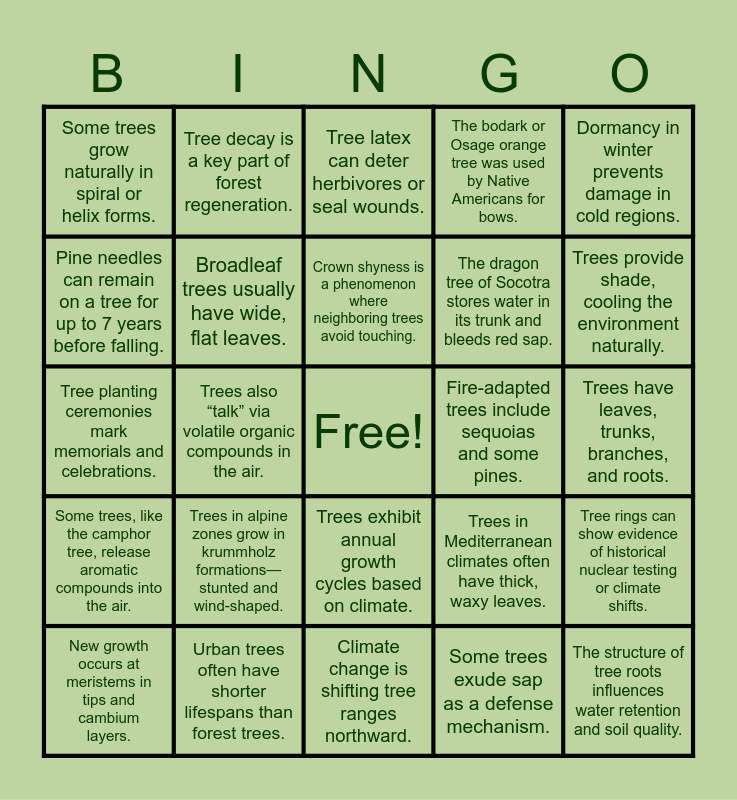
This bingo card has a free space and 301 words: Trees can produce different sounds when stressed, detectable with specialized equipment., The tamarack is a rare deciduous conifer—it sheds its needles annually., Some trees, like the camphor tree, release aromatic compounds into the air., Tree roots sometimes form natural grafts between individuals of the same species., The dragon tree of Socotra stores water in its trunk and bleeds red sap., The Japanese cedar, or sugi, is Japan’s national tree., Tree bark can be smooth, scaly, ridged, or corky depending on species and age., The silver birch reflects more sunlight than most trees due to its white bark., Trees can influence each other’s growth through shading and allelopathy., Allelopathy is when a tree releases chemicals that inhibit other plants’ growth., Trees growing in exposed areas often develop asymmetrical crowns., The tamarugo tree in Chile absorbs moisture from fog through its leaves., Olive trees can live and bear fruit for over a thousand years., Certain fig trees are considered keystone species in tropical ecosystems., The kapok tree is sacred in many Central American cultures., Joshua trees are actually a type of yucca, classified as a tree-like monocot., Some trees are protected by UNESCO as part of cultural landscapes., The “General Sherman” sequoia is the largest tree by volume., Black walnut trees produce juglone, a chemical toxic to many nearby plants., The cork oak must be at least 25 years old before bark can be harvested., Some African acacia trees have symbiotic relationships with stinging ants., Trees in alpine zones grow in krummholz formations—stunted and wind-shaped., The “moon trees” were grown from seeds taken to the moon on Apollo 14., Trees can suffer from sunscald if exposed suddenly to strong sunlight., Urban trees often have shorter lifespans than forest trees., Trees in windy regions may grow with a permanent lean., Tree roots can sometimes intrude into water pipes or building foundations., Some trees grow naturally in spiral or helix forms., Willow trees are often planted to stabilize riverbanks., The sycamore fig was one of the first cultivated trees in Africa., Tree pollen can travel hundreds of miles on the wind., Some trees are known to “weep” water through guttation at night., Pine needles can remain on a tree for up to 7 years before falling., Certain tree species can regenerate completely from stumps., The inner bark of some trees was used as emergency food by indigenous peoples., Ironwood trees are named for their incredibly dense, hard wood., Tree crowns form distinct shapes useful for species identification., Elm trees were traditionally planted along streets for their arching canopies., The linden or basswood tree is favored by bees for nectar., Trees like tamarind and carob produce edible seed pods., Some ancient trees are preserved in arboreta and botanical gardens., The banyan tree grows massive aerial roots that become new trunks., The moringa tree is valued for its highly nutritious leaves., Paper was originally made from tree fibers like papyrus and mulberry., Bamboo, while not a true tree, is the fastest growing woody plant., The cashew tree produces both fruit and nut from a single flower., Trees can trap particulate pollution on their leaves and bark., Coastal trees like palms and mangroves are adapted to saline soils., The Joshua tree depends on a specific moth species for pollination., Trees in Mediterranean climates often have thick, waxy leaves., Ash wood is prized for tool handles and baseball bats., Some trees contain alkaloids used in pharmaceuticals., Yew tree bark led to the development of the cancer drug paclitaxel., Dogwood trees bloom early in spring with distinctive flowers., Fruit-bearing trees are vital for traditional agroforestry systems., Some tropical trees produce cauliflorous flowers—on trunks rather than branches., Mistletoe, a parasitic plant, often grows on hardwood trees., The bodark or Osage orange tree was used by Native Americans for bows., Trees may exhibit epicormic growth—shoots from trunks after stress or fire., Japanese maples are cultivated for their ornamental leaf color and form., Larch trees turn golden yellow before shedding needles in autumn., Giant sequoias rely on fire to open their cones and clear ground for seedlings., Tree sap flow is often stronger during cold nights followed by warm days., The term “tree line” marks the altitude beyond which trees cannot grow., High-altitude trees may have twisted, gnarled forms due to wind and cold., Trees in Arctic tundra are typically dwarfed and shrub-like., Tree species can be indicators of soil type or health., Some eucalyptus trees shed bark in long strips to reduce pests., The baobab's trunk can reach over 30 feet in diameter., Rainforests are home to “emergent trees” that tower above the canopy., Some fig trees rely on a single species of wasp for pollination., Certain tropical trees produce edible flowers, like the banana blossom., The camellia tree’s seeds are pressed for tea oil in East Asia., Mountain ash trees are not true ashes but belong to the rose family., The native “kōwhai” tree is one of New Zealand’s most beloved native trees., Many urban planners use ginkgo trees due to their pollution resistance., Trees can act as living fences or property markers., Almond trees are part of the rose family and bloom early in spring., The sandalwood tree is semiparasitic, tapping roots of neighboring plants., Some desert trees use reflective hairs to limit sun exposure., Trees have been genetically engineered for faster growth or pest resistance., Tree rings can show evidence of historical nuclear testing or climate shifts., Certain tree bark, like birch, is naturally water-resistant., Acacia trees in Australia can survive extreme drought and fire., The whistling thorn tree’s hollow thorns serve as ant homes., Some trees host “fairy rings” of mushrooms from underground mycelium., Conifer trees typically grow in spiral phyllotaxis patterns., Paperbark trees shed entire layers of bark to avoid parasites., Bonsai trees are shaped using wire, pruning, and careful root control., The tulip tree is known for its large, tulip-shaped flowers., Trees support entire trophic levels, from decomposers to predators., Some trees like the golden wattle are national symbols (Australia)., The monkey puzzle tree dates back to the age of the dinosaurs., Trees are often used in reforestation and climate restoration projects., Bees and other pollinators depend on flowering trees as early food sources., In forestry, “crown thinning” is a pruning method to improve light and airflow., The white oak can live for centuries and grow massive limbs., Ancient tree stumps in the fossil record show early forest formation., The African blackwood is one of the most expensive timbers due to its density., Trees can form “living bridges” through trained root systems in India., Some trees evolved thick bark specifically as fire protection., Leaves from certain trees are used in traditional textiles and crafts., Tree carvings and scars can last for decades or longer., Tree populations help regulate watershed dynamics., Woodpeckers and other cavity-nesters rely on old trees for homes., The structure of tree roots influences water retention and soil quality., The health of a forest can often be judged by the condition of its trees., Trees are the longest-living organisms on Earth., Dead trees still offer ecological value as habitats and nutrient sources., Trees produce the oxygen we breathe., They absorb carbon dioxide and help reduce climate change., Trees provide shade, cooling the environment naturally., Many trees live for hundreds or even thousands of years., Some tree species can grow over 300 feet tall., The tallest known tree is a coast redwood named Hyperion., Trees have leaves, trunks, branches, and roots., Leaves are the main site of photosynthesis., Roots anchor trees and absorb water and nutrients., The trunk of a tree is made of layers: bark, cambium, xylem, and heartwood., The bark protects the inner living tissue of a tree., Tree rings indicate a tree’s age and past climate conditions., Trees are classified as either deciduous (lose leaves) or evergreen (keep leaves year-round)., Deciduous trees shed their leaves in autumn., Evergreens retain foliage through all seasons., Broadleaf trees usually have wide, flat leaves., Conifers bear cones and have needle-like leaves., Maples, oaks, and birches are common broadleaf trees., Pines, firs, and spruces are typical conifers., Fruit trees like apples and cherries bloom in spring., Tree flowers are often pollinated by wind or insects., Many trees rely on bees, birds, or bats for pollination., Seeds are dispersed by wind, animals, or water., Some seeds need fire or freezing to germinate., Trees provide habitat for thousands of species., Birds nest in branches; insects live in bark and leaves., Trees reduce soil erosion by stabilizing the ground with roots., Urban trees improve air quality and reduce noise., A single mature tree can absorb about 48 pounds of CO₂ per year., Tree roots can grow 2–3 times wider than the tree’s crown., Leaves “breathe” through tiny pores called stomata., Trees communicate through underground fungal networks., This network is called the “Wood Wide Web.”, Trees share nutrients with weaker neighbors via these fungal connections., Some trees release chemicals to warn others of insect attacks., Trees also “talk” via volatile organic compounds in the air., Autumn leaf color changes are triggered by shorter daylight hours., Chlorophyll breaks down in fall, revealing reds and yellows., Anthocyanins cause red and purple hues in fall leaves., Ginkgo trees have fan-shaped leaves and are living fossils., The ginkgo species is over 200 million years old., Bristlecone pines are the oldest living trees—some are over 4,800 years old., Redwoods are among the tallest and oldest tree species., Baobab trees can store thousands of liters of water in their trunks., Mangroves grow in saltwater and stabilize coastlines., Trees play a role in the water cycle via transpiration., Tree canopies influence local rainfall by releasing moisture., Some trees “drip-tip” their leaves to shed water efficiently., Tropical rainforest trees form dense upper canopies., The Amazon has over 16,000 tree species., Tree wood is made of cellulose and lignin., Lignin gives wood its rigidity and resistance., Some trees produce latex, resins, or gums., Rubber comes from the latex of the rubber tree (Hevea brasiliensis)., Frankincense and myrrh are tree resins used for incense., Cinnamon comes from the inner bark of a tree., Cork is harvested from the bark of the cork oak., Maple syrup is made from the sap of sugar maples., Tree leaves and bark have been used medicinally for centuries., Willow bark contains salicin, the precursor to aspirin., Trees grow in three main zones: roots, trunk, and crown., New growth occurs at meristems in tips and cambium layers., The cambium produces xylem (wood) and phloem (inner bark)., Xylem transports water upward from roots., Phloem transports sugars down from leaves., Buttress roots support large tropical trees., Tree canopies influence biodiversity and microclimates., Some trees like oaks are keystone species in ecosystems., Acorns from oak trees feed countless wildlife., Some trees need animal digestion to germinate seeds., Eucalyptus leaves are toxic to most animals, but koalas can digest them., Monkeypod trees close their leaves at night., The African “Tree of Life” is the baobab., The “Tree of Heaven” is an invasive species in many places., Trees can suffer from fungal infections, blight, and borers., Dutch elm disease decimated American elm populations., Chestnut blight wiped out most American chestnuts., Ash trees are threatened by emerald ash borers., Trees adapt to wind by growing thicker trunks., Wind-pollinated trees like birches and oaks produce huge amounts of pollen., Tree pollen is a major allergen., Some trees reproduce clonally via suckers or root sprouts., Aspen groves can be massive single organisms., The largest organism on Earth by mass is a clonal aspen colony in Utah named “Pando.”, Trees can detect gravity (gravitropism) and grow accordingly., Certain trees exhibit nyctinasty—leaf movement based on time of day., Some tree leaves fold up in response to touch or light., Trees exhibit annual growth cycles based on climate., Dormancy in winter prevents damage in cold regions., Tropical trees may grow year-round., Tree bark patterns can help identify species., Sycamore bark flakes off in irregular patches., Birch bark peels in horizontal strips., Bark thickness can protect against fire and pests., Fire-adapted trees include sequoias and some pines., Jack pine cones open only with intense heat., Serotinous cones remain sealed until triggered by fire., Mangroves filter saltwater through specialized roots., Some trees exude sap as a defense mechanism., Trees under stress may flower or fruit more abundantly., Tree wood can be hard (oak, mahogany) or soft (pine, cedar)., Hardness is not related to density but to cellular structure., Tree wood shows annual rings due to seasonal growth., Dendrochronology is the study of tree rings to date events., Tree rings can reveal volcanic eruptions or droughts., Ring patterns vary with rainfall, temperature, and soil., Cambial damage can cause abnormal ring shapes., Some trees show spiral or twisted growth due to genetics., Trees can survive partial trunk loss if cambium remains intact., Coppicing is cutting trees to ground level to encourage regrowth., Pollarding is trimming upper branches to control size., Topiary is the art of sculpting trees into shapes., Bonsai is the cultivation of miniature trees in pots., Some bonsai trees are over 1,000 years old., Tree roots can break through rock or pavement over time., Ficus trees often start as epiphytes and become “strangler figs.”, Tamarind trees produce sour, edible pods., Some tropical trees grow aerial prop roots for support., Mangroves use pneumatophores to breathe above water., Tree latex can deter herbivores or seal wounds., The kapok tree produces buoyant, fibrous seed fluff., Trees can “bleed” colored sap—like the dragon’s blood tree., The rainbow eucalyptus has multicolored peeling bark., Trees have circadian rhythms influenced by light and temperature., Some trees regulate internal clocks even in constant darkness., The moon’s cycles can affect sap flow in some species., Trees near rivers may lean due to soil erosion., Urban trees suffer stress from compacted soil and pollution., Lightning often strikes tall, isolated trees., Trees can recover from fire or lightning if damage is limited., Trees form “burls”—knobby growths from stress or infection., Witches' brooms are tangled branch clusters caused by pathogens., Trees can naturally graft roots or branches together., Inosculation is the fusion of two trees through contact., Some tree species hybridize easily; others don’t., Trees are important symbols in many mythologies., The Norse Yggdrasil is a cosmic world tree., Bodhi trees are sacred in Buddhism—Siddhartha attained enlightenment under one., Oak trees were sacred to Druids., Certain tree species are protected by law in countries., Urban tree planting improves health and reduces crime., Street trees increase property values., Trees are often used in phytoremediation to clean soil., Poplars and willows can absorb toxins from groundwater., Tree leaves contain compounds used in perfumes and oils., Sandalwood trees are prized for aromatic wood., Aromatic oils often come from tree bark or leaves., Tree fossils help reconstruct prehistoric ecosystems., Some fossil trees date back over 300 million years., Coal formed from ancient tree material in swamps., Petrified wood is fossilized tree tissue replaced with minerals., Tree crowns compete for light, shaping forest structure., Crown shyness is a phenomenon where neighboring trees avoid touching., Mangroves protect coastlines from storms and erosion., Some trees close their stomata to reduce water loss., Trees may shed branches in drought as a survival strategy., In arid areas, trees may grow very slowly but live longer., Ancient oaks are often hollow yet still alive., Lightning scars may spiral around tree trunks., Trees can host hundreds of epiphytic species in rainforests., Bats roost in hollow tree trunks., Lianas and vines climb trees to reach sunlight., Tree hollows form from decay or injury over time., Old trees contribute more to carbon storage than young ones., Some conservationists call large trees “climate giants.”, Logging old-growth forests can release massive carbon stores., Tree canopies regulate forest humidity., Fallen trees become “nurse logs” for seedlings., Deadwood supports fungi, beetles, and mosses., Tree decay is a key part of forest regeneration., Even standing dead trees (“snags”) provide habitat., Tree roots grow toward moisture gradients., Trees in dry areas may send roots tens of meters deep., Some trees synchronize flowering or fruiting cycles., The durian tree produces pungent, spiky fruit., Tree branches follow fractal geometry patterns., Leaves often follow Fibonacci spirals in arrangement., Some ancient cultures believed trees had spirits., Trees appear in over 60 national flags and emblems., Tree planting ceremonies mark memorials and celebrations., World Tree Day is celebrated globally for awareness., Trees reduce stormwater runoff in cities., Tree-lined streets reduce urban heat islands., Sapwood conducts water; heartwood provides strength., Sap flow varies with temperature and season., Some tree species glow faintly due to bioluminescent fungi., “Ghost forests” appear when trees die from rising seas., Climate change is shifting tree ranges northward., Genetic modification may help trees resist pests., “Tree banks” preserve rare species for future planting., Biochar from trees improves soil fertility. and Trees are vital to planetary life—and our survival..
Eco-Bingo | Plant Characteristics Bingo | Main Idea | Plant Characteristics Bingo | PLANT CHARACTERISTICS
Share this URL with your players:
For more control of your online game, create a clone of this card first.
Learn how to conduct a bingo game.
With players vying for a you'll have to call about __ items before someone wins. There's a __% chance that a lucky player would win after calling __ items.
Tip: If you want your game to last longer (on average), add more unique words/images to it.