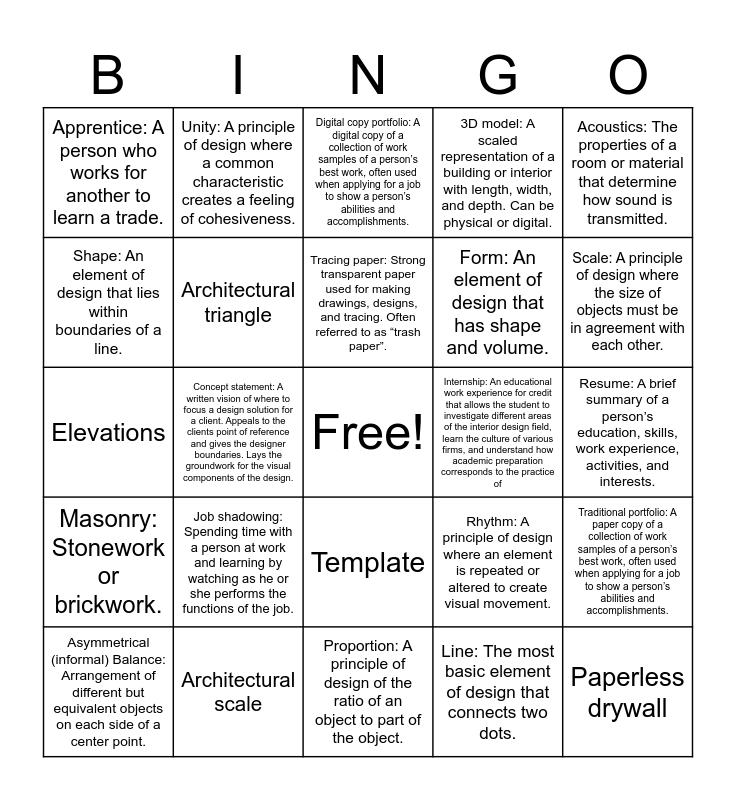
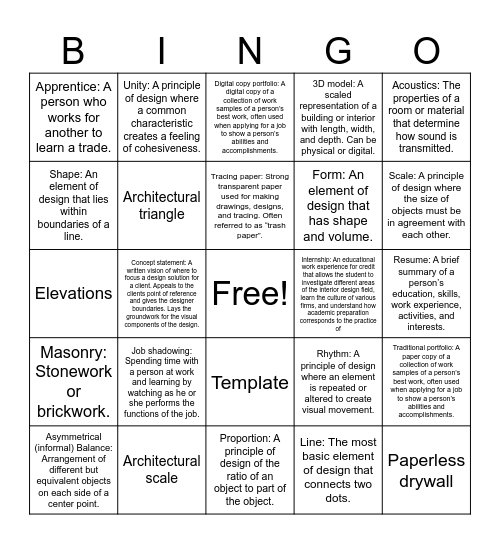
This bingo card has a free space and 40 words: Floor plan, Elevations, T-square: T-shaped ruler used in mechanical drawings to create horizontal lines., Architectural triangle, Architectural scale, Template, Tracing paper: Strong transparent paper used for making drawings, designs, and tracing. Often referred to as “trash paper”., CADD: Computer-aided drawing and design software that speeds the process in creating plans that are accurate and industry accepted., Acoustics: The properties of a room or material that determine how sound is transmitted., Masonry: Stonework or brickwork., Concept statement: A written vision of where to focus a design solution for a client. Appeals to the clients point of reference and gives the designer boundaries. Lays the groundwork for the visual components of the design., 3D model: A scaled representation of a building or interior with length, width, and depth. Can be physical or digital., Paperless drywall, Resume: A brief summary of a person’s education, skills, work experience, activities, and interests., Internship: An educational work experience for credit that allows the student to investigate different areas of the interior design field, learn the culture of various firms, and understand how academic preparation corresponds to the practice of, Job shadowing: Spending time with a person at work and learning by watching as he or she performs the functions of the job., Service learning: A method of learning that combines classroom instruction with meaningful community service., Apprentice: A person who works for another to learn a trade., Work samples/artifacts: Photographs, floor-plan drawings, free-hand sketches, or conceptual models of work that you have done. Will be used in a portfolio to showcase your work to future clients., Digital copy portfolio: A digital copy of a collection of work samples of a person’s best work, often used when applying for a job to show a person’s abilities and accomplishments., Traditional portfolio: A paper copy of a collection of work samples of a person’s best work, often used when applying for a job to show a person’s abilities and accomplishments., Line: The most basic element of design that connects two dots., Form: An element of design that has shape and volume., Shape: An element of design that lies within boundaries of a line., Space: The area around or inside of a form., Texture: An element of design that relates to how something feels or appears to feel., Pattern: The repetition of a design in an orderly manner., Color: The most important element of design., Principles of design: Guidelines designers use to create good design using the elements of design., Balance: A principle of design where the elements are in equilibrium., Symmetrical (formal) Balance: Identical proportion and arrangement of objects on both sides of a center point., Asymmetrical (informal) Balance: Arrangement of different but equivalent objects on each side of a center point., Emphasis: A principle of design that is the focal point., Rhythm: A principle of design where an element is repeated or altered to create visual movement., Scale: A principle of design where the size of objects must be in agreement with each other., Proportion: A principle of design of the ratio of an object to part of the object., Golden mean: Proportions that are unequal ratios are more pleasing than ratios that are equal., Variety: A principle of design where change is made to part of a design to keep a design from being boring., Unity: A principle of design where a common characteristic creates a feeling of cohesiveness. and Harmony: The end result when the elements and principles work together to create aesthetically pleasing design..
Art Vocabulary | Technical Theatre BING! | Art Bingo | Watercolor/art | Sculpture 1 Module 1 Bingo
Share this URL with your players:
For more control of your online game, create a clone of this card first.
Learn how to conduct a bingo game.
With players vying for a you'll have to call about __ items before someone wins. There's a __% chance that a lucky player would win after calling __ items.
Tip: If you want your game to last longer (on average), add more unique words/images to it.