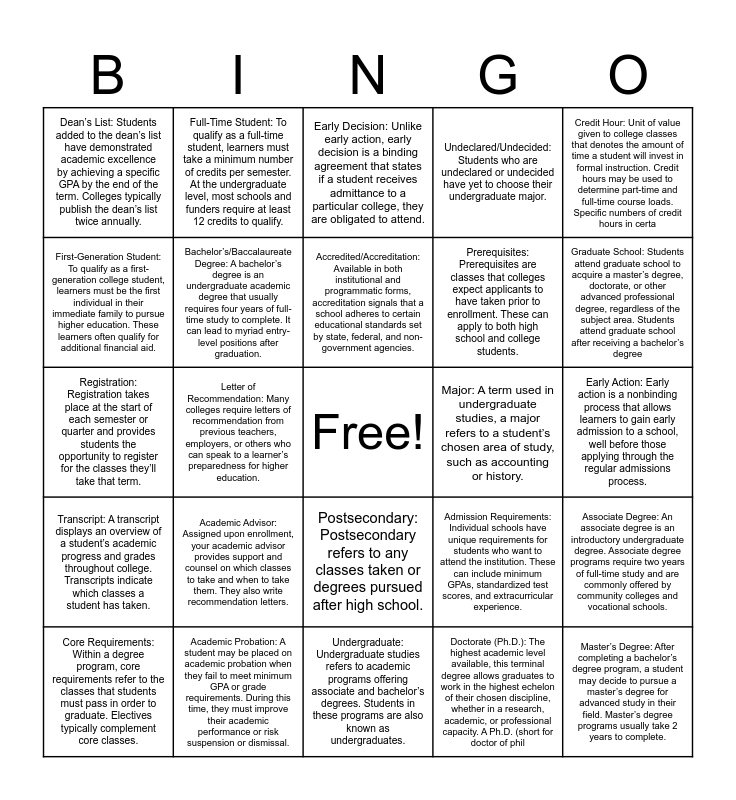
This bingo card has a free space and 24 words: Academic Advisor: Assigned upon enrollment, your academic advisor provides support and counsel on which classes to take and when to take them. They also write recommendation letters., Academic Probation: A student may be placed on academic probation when they fail to meet minimum GPA or grade requirements. During this time, they must improve their academic performance or risk suspension or dismissal., Accredited/Accreditation: Available in both institutional and programmatic forms, accreditation signals that a school adheres to certain educational standards set by state, federal, and non-government agencies., Core Requirements: Within a degree program, core requirements refer to the classes that students must pass in order to graduate. Electives typically complement core classes., Credit Hour: Unit of value given to college classes that denotes the amount of time a student will invest in formal instruction. Credit hours may be used to determine part-time and full-time course loads. Specific numbers of credit hours in certa, Dean’s List: Students added to the dean’s list have demonstrated academic excellence by achieving a specific GPA by the end of the term. Colleges typically publish the dean’s list twice annually., First-Generation Student: To qualify as a first-generation college student, learners must be the first individual in their immediate family to pursue higher education. These learners often qualify for additional financial aid., Full-Time Student: To qualify as a full-time student, learners must take a minimum number of credits per semester. At the undergraduate level, most schools and funders require at least 12 credits to qualify., Major: A term used in undergraduate studies, a major refers to a student’s chosen area of study, such as accounting or history., Postsecondary: Postsecondary refers to any classes taken or degrees pursued after high school., Prerequisites: Prerequisites are classes that colleges expect applicants to have taken prior to enrollment. These can apply to both high school and college students., Registration: Registration takes place at the start of each semester or quarter and provides students the opportunity to register for the classes they’ll take that term., Admission Requirements: Individual schools have unique requirements for students who want to attend the institution. These can include minimum GPAs, standardized test scores, and extracurricular experience., Associate Degree: An associate degree is an introductory undergraduate degree. Associate degree programs require two years of full-time study and are commonly offered by community colleges and vocational schools., Bachelor’s/Baccalaureate Degree: A bachelor’s degree is an undergraduate academic degree that usually requires four years of full-time study to complete. It can lead to myriad entry-level positions after graduation., Doctorate (Ph.D.): The highest academic level available, this terminal degree allows graduates to work in the highest echelon of their chosen discipline, whether in a research, academic, or professional capacity. A Ph.D. (short for doctor of phil, Early Action: Early action is a nonbinding process that allows learners to gain early admission to a school, well before those applying through the regular admissions process., Early Decision: Unlike early action, early decision is a binding agreement that states if a student receives admittance to a particular college, they are obligated to attend., Graduate School: Students attend graduate school to acquire a master’s degree, doctorate, or other advanced professional degree, regardless of the subject area. Students attend graduate school after receiving a bachelor’s degree, Letter of Recommendation: Many colleges require letters of recommendation from previous teachers, employers, or others who can speak to a learner’s preparedness for higher education., Master’s Degree: After completing a bachelor’s degree program, a student may decide to pursue a master’s degree for advanced study in their field. Master’s degree programs usually take 2 years to complete., Transcript: A transcript displays an overview of a student’s academic progress and grades throughout college. Transcripts indicate which classes a student has taken., Undeclared/Undecided: Students who are undeclared or undecided have yet to choose their undergraduate major. and Undergraduate: Undergraduate studies refers to academic programs offering associate and bachelor’s degrees. Students in these programs are also known as undergraduates..
College Vocab Bingo | College Vocabulary | College Bingo | Career Chat Live Bingo | University Vocabulary
Share this URL with your players:
For more control of your online game, create a clone of this card first.
Learn how to conduct a bingo game.
With players vying for a you'll have to call about __ items before someone wins. There's a __% chance that a lucky player would win after calling __ items.
Tip: If you want your game to last longer (on average), add more unique words/images to it.