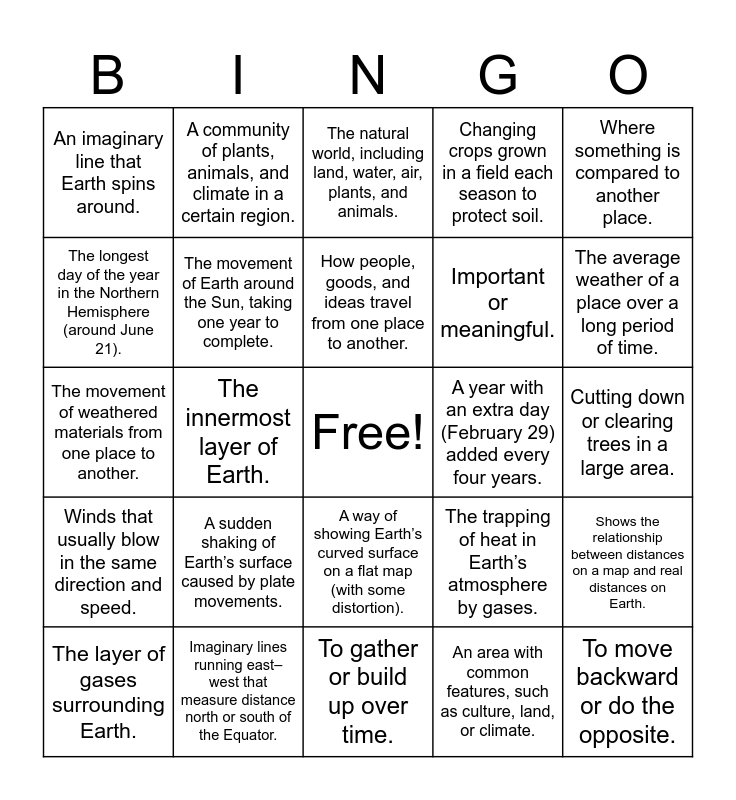
This bingo card has a free space and 83 words: The exact spot on Earth, given by latitude and longitude., Where something is compared to another place., The natural world, including land, water, air, plants, and animals., A period of 10 years., A period of 100 years., A period of 1,000 years., Technology that uses satellites to find exact locations., A system that stores and analyzes map data., A big idea or subject of study in geography., The study of Earth’s natural features, landforms, and processes., The Sun and all the planets, moons, and other objects that orbit it., The curved path an object takes around another object in space., The movement of Earth around the Sun, taking one year to complete., A year with an extra day (February 29) added every four years., The spinning of Earth on its axis., An imaginary line that Earth spins around., The layer of gases surrounding Earth., The longest day of the year in the Northern Hemisphere (around June 21)., The shortest day of the year in the Northern Hemisphere (around December 21)., The time of year when day and night are equal in length., The region between the Tropic of Cancer and the Tropic of Capricorn., Important or meaningful., To move backward or do the opposite., Exactly the same., The innermost layer of Earth., Melted rock found beneath Earth’s crust., The thick layer of rock between Earth’s core and crust., The thin, outermost layer of Earth., A large continuous landmass on Earth., The theory that Earth’s crust is broken into plates that move., A sudden shaking of Earth’s surface caused by plate movements., A crack in Earth’s crust where movement occurs., The breaking down of rocks into smaller pieces., The movement of weathered materials from one place to another., To let out or give off., Staying the same over time., To gather or build up over time., The condition of the air at a certain time and place., The average weather of a place over a long period of time., Winds that usually blow in the same direction and speed., A steady, moving stream of water in the ocean., A climate event where warm water causes unusual weather patterns., A climate event where cooler water causes unusual weather patterns., Winds that blow over small areas., An area that receives little rainfall because mountains block moist air., Areas with similar weather patterns and temperatures., A community of plants, animals, and climate in a certain region., Weather conditions that are affected by cities, such as higher temperatures., Dirty air pollution that forms a thick haze., Rain mixed with harmful chemicals from pollution., The trapping of heat in Earth’s atmosphere by gases., Changing crops grown in a field each season to protect soil., Cutting down or clearing trees in a large area., The careful use of resources to avoid waste., Supplying water to crops through artificial means., A chemical used to kill insects or other pests., A community of living things interacting with their environment., The variety of living things in an ecosystem., Imaginary lines running east–west that measure distance north or south of the Equator., Imaginary lines running north–south that measure distance east or west of the Prime Meridian., The 0° latitude line that divides Earth into the Northern and Southern Hemispheres., The 0° longitude line that divides Earth into the Eastern and Western Hemispheres., The exact spot on Earth, given by latitude and longitude., Where something is compared to another place., Half of the Earth (Northern, Southern, Eastern, or Western)., Shows the relationship between distances on a map and real distances on Earth., A symbol that shows directions (north, south, east, west) on a map., Explains the symbols, colors, and lines used on a map., A map that shows landforms, water, and natural features., A map that shows countries, states, and borders., A map that focuses on one theme, like climate, population, or resources., A 3D model of Earth., A person who makes maps., A way of showing Earth’s curved surface on a flat map (with some distortion)., An area with common features, such as culture, land, or climate., Describes what makes a location unique (landforms, people, culture)., How people adapt to and change their surroundings., How people, goods, and ideas travel from one place to another., Technology that uses satellites to find exact locations., A system that stores and analyzes map data., Location, Place, Region, Movement, and Human-Environment Interaction., The 7 large landmasses on Earth (Africa, Asia, etc.). and The 5 large bodies of salt water on Earth (Pacific, Atlantic, etc.)..
⚠ This card has duplicate items: The exact spot on Earth, given by latitude and longitude. (2), Where something is compared to another place. (2), Technology that uses satellites to find exact locations. (2), A system that stores and analyzes map data. (2)
Ocean, Atmosphere, & Climate | Map/Globe Practice | Multiple Meaning Words | Weather Review Bingo | Weather Review Bingo
Share this URL with your players:
For more control of your online game, create a clone of this card first.
Learn how to conduct a bingo game.
With players vying for a you'll have to call about __ items before someone wins. There's a __% chance that a lucky player would win after calling __ items.
Tip: If you want your game to last longer (on average), add more unique words/images to it.