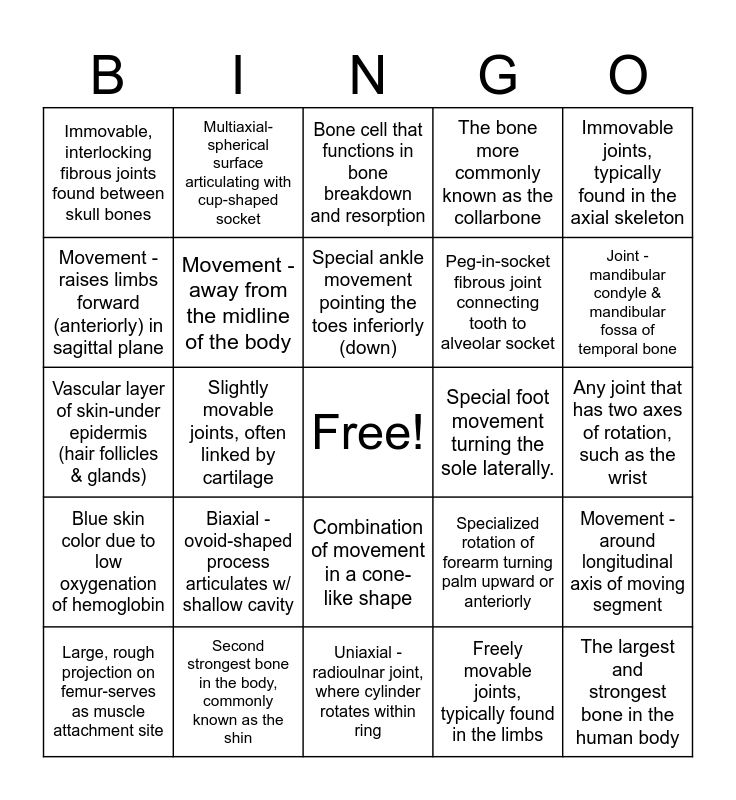
This bingo card has a free space and 52 words: Bone in upper limb - head forms the "ball" of shoulder joint, The largest and strongest bone in the human body, Uniaxial - like elbow, allowing flexion and extension., Uniaxial - radioulnar joint, where cylinder rotates within ring, Biaxial - ovoid-shaped process articulates w/ shallow cavity, Biaxial - concave in one direction & convex in other (thumb), Multiaxial- spherical surface articulating with cup-shaped socket, Joint type - flat/nearly flat articular surfaces allowing gliding, Movement - raises limbs forward (anteriorly) in sagittal plane, Movement - moves limbs backward (posteriorly)in sagittal plane, Movement - away from the midline of the body, Movement - toward the midline of the body, Movement - around longitudinal axis of moving segment, Specialized rotation of forearm turning palm upward or anteriorly, Rotation of forearm turning palm downward or posteriorly, Special ankle movement moving foot superiorly toward the shin, Special ankle movement pointing the toes inferiorly (down), Special foot movement turning the sole laterally., Hand movement forming a "pincer" grasp with thumb and fingers, Immovable joints, typically found in the axial skeleton, Slightly movable joints, often linked by cartilage, Freely movable joints, typically found in the limbs, Immovable, interlocking fibrous joints found between skull bones, Peg-in-socket fibrous joint connecting tooth to alveolar socket, Slippery fluid inside synovial joint cavity that reduces friction, Fibrous sacs of synovial fluid that decrease friction, Narrow passage - wrist - when compressed, causes weakness in hand, Most common torn ligament (knee)- sudden turns/direct blows, Joint - mandibular condyle & mandibular fossa of temporal bone, Hyaline cartilage covering ends of bones in synovial joints, The bone more commonly known as the shoulder blade, The bone more commonly known as the collarbone, Carpal bone that articulates with the radius & lunate, Superior tarsal bone - articulates with tibia & fibula, Large, cup-shaped socket in the pelvis articulating with femur, Bone cell that functions in bone breakdown and resorption, Second strongest bone in the body, commonly known as the shin, Epidermis cell - produce filaments for structure & waterproofing, Most dangerous type of skin cancer - highly metastatic., Classification of joints connected by dense tissue, like sutures, Cartilaginous joint, allows slight movement-pubic bone connection, Any joint that has two axes of rotation, such as the wrist, Blue skin color due to low oxygenation of hemoglobin, The kneecap; a sesamoid bone within the thigh muscle tendon, Combination of movement in a cone-like shape, Layer of integumentary system - adipose & anchors skin to muscle, The superficial, avascular region of the skin., Vascular layer of skin-under epidermis (hair follicles & glands), Joint class connected by cartilage tissue w/no joint cavity, Bone disease - resorption exceeds deposit, decline in bone mass, Large, rough projection on femur-serves as muscle attachment site and The bones of the fingers and toes.
Exam 2 - Cody Mon Call List' | Skeletal, Muscular and Articular System | Skeletal Muscles | SPEED BINGO! | GCSE PE bones and muscles
Share this URL with your players:
For more control of your online game, create a clone of this card first.
Learn how to conduct a bingo game.
With players vying for a you'll have to call about __ items before someone wins. There's a __% chance that a lucky player would win after calling __ items.
Tip: If you want your game to last longer (on average), add more unique words/images to it.