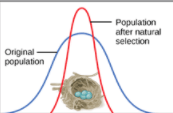
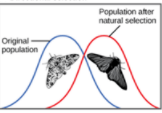
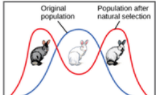
ArtificialSelectionprocess in thebreeding of animalsand in the cultivationof plants by which thebreeder chooses thetraits wantedStabilizingSelectionAnalogousstructuresfeatures ofdifferent speciesthat are similar infunction but notnecessarily instructureExtinctionthe completedying out ofa speciesDisruptiveSelectionNaturalSelectionorganisms betteradapted to theirenvironment tendto survive andproduce moreoffspringSpeciationthe formation ofnew anddistinct speciesin the course ofevolutionMigrationseasonalmovement ofanimals fromone region toanotherFitnessrepresentationof individualreproductivesuccessPopulationorganisms of thesame species thatlive in a particulargeographic areaSpeciesa group of livingorganisms consistingof similar individualscapable ofexchanging genes orinterbreedingEvolutionA changeover aperiod oftimeDirectionalSelectionCoevolutionThe influence ofcloselyassociatedspecies on eachother in theirevolution.vestigialstructurescells, tissues,and organs in abody which nolonger serve afunctionFounderEffectreduced geneticdiversity whichresults when apopulation isdescended from asmall number ofcolonizing ancestors.Hardy-weinbergEquationp^2 +2pq +q^2 = 1Adaptationprocess of changeby which anorganism orspecies becomesbetter suited to itsenvironment.Geneticdriftvariation in the relativefrequency of differentgenotypes in a smallpopulation, owing tothe chancedisappearance ofparticular genes asindividuals die or donot reproduceBottleneckeffectwhen a speciesgoes through anevent thatsuddenly andsignificantlyreduces itspopulationMutationchanging of the structure ofa gene caused by thealteration of single baseunits in DNA, or thedeletion, insertion, orrearrangement of largersections of genes orchromosomeshomologousstructuresbody parts ofanimals thathave asimilarstructureCharlesDarwinCame upwith thetheory ofNaturalSelectionGenepoolthe collection ofdifferent geneswithin aninterbreedingpopulation. ArtificialSelectionprocess in thebreeding of animalsand in the cultivationof plants by which thebreeder chooses thetraits wantedStabilizingSelectionAnalogousstructuresfeatures ofdifferent speciesthat are similar infunction but notnecessarily instructureExtinctionthe completedying out ofa speciesDisruptiveSelectionNaturalSelectionorganisms betteradapted to theirenvironment tendto survive andproduce moreoffspringSpeciationthe formation ofnew anddistinct speciesin the course ofevolutionMigrationseasonalmovement ofanimals fromone region toanotherFitnessrepresentationof individualreproductivesuccessPopulationorganisms of thesame species thatlive in a particulargeographic areaSpeciesa group of livingorganisms consistingof similar individualscapable ofexchanging genes orinterbreedingEvolutionA changeover aperiod oftimeDirectionalSelectionCoevolutionThe influence ofcloselyassociatedspecies on eachother in theirevolution.vestigialstructurescells, tissues,and organs in abody which nolonger serve afunctionFounderEffectreduced geneticdiversity whichresults when apopulation isdescended from asmall number ofcolonizing ancestors.Hardy-weinbergEquationp^2 +2pq +q^2 = 1Adaptationprocess of changeby which anorganism orspecies becomesbetter suited to itsenvironment.Geneticdriftvariation in the relativefrequency of differentgenotypes in a smallpopulation, owing tothe chancedisappearance ofparticular genes asindividuals die or donot reproduceBottleneckeffectwhen a speciesgoes through anevent thatsuddenly andsignificantlyreduces itspopulationMutationchanging of the structure ofa gene caused by thealteration of single baseunits in DNA, or thedeletion, insertion, orrearrangement of largersections of genes orchromosomeshomologousstructuresbody parts ofanimals thathave asimilarstructureCharlesDarwinCame upwith thetheory ofNaturalSelectionGenepoolthe collection ofdifferent geneswithin aninterbreedingpopulation. 

Population Genetics Bingo! - Call List

(Print) Use this randomly generated list as your call list when playing the game. There is no need to say the BINGO column name. Place some kind of mark (like an X, a checkmark, a dot, tally mark, etc) on each cell as you announce it, to keep track. You can also cut out each item, place them in a bag and pull words from the bag.


1
2
3
4
5
6
7
8
9
10
11
12
13
14
15
16
17
18
19
20
21
22
23
24
  1. process in the breeding of animals and in the cultivation of plants by which the breeder chooses the traits wanted
    Artificial Selection

  2. Stabilizing Selection
  3. features of different species that are similar in function but not necessarily in structure
    Analogous structures
  4. the complete dying out of a species
    Extinction
  5. Disruptive Selection
  6. organisms better adapted to their environment tend to survive and produce more offspring
    Natural Selection
  7. the formation of new and distinct species in the course of evolution
    Speciation
  8. seasonal movement of animals from one region to another
    Migration
  9. representation of individual reproductive success
    Fitness
  10. organisms of the same species that live in a particular geographic area
    Population
  11. a group of living organisms consisting of similar individuals capable of exchanging genes or interbreeding
    Species
  12. A change over a period of time
    Evolution
  13. Directional Selection
  14. The influence of closely associated species on each other in their evolution.
    Coevolution
  15. cells, tissues, and organs in a body which no longer serve a function
    vestigial structures
  16. reduced genetic diversity which results when a population is descended from a small number of colonizing ancestors.
    Founder Effect
  17. p^2 + 2pq + q^2 = 1
    Hardy-weinberg Equation
  18. process of change by which an organism or species becomes better suited to its environment.
    Adaptation
  19. variation in the relative frequency of different genotypes in a small population, owing to the chance disappearance of particular genes as individuals die or do not reproduce
    Genetic drift
  20. when a species goes through an event that suddenly and significantly reduces its population
    Bottle neck effect
  21. changing of the structure of a gene caused by the alteration of single base units in DNA, or the deletion, insertion, or rearrangement of larger sections of genes or chromosomes
    Mutation
  22. body parts of animals that have a similar structure
    homologous structures
  23. Came up with the theory of Natural Selection
    Charles Darwin
  24. the collection of different genes within an interbreeding population.
    Gene pool