Frequencynumber ofwave cyclesthat pass agiven pointper unit timeDiffractionThe behaviorof a wave asit bendsaround asharp edgeLongitudinalWaveA wave that ismoving in thesame direction asthe displacementof the transmittingmediumWavelengthThe distancebetween twoadjacent crestsor troughs of awaveAbsorptionthe transfer ofthe energy of awave to matteras the wavepasses throughitElectromagneticRadiationEnergy that ischaracterized based on thefrequency and wavelengthof the oscillations as radiowaves, microwaves,infrared radiation, visiblelight, ultraviolet radiation,X-rays and gamma raysVisiblelightElectromagneticwaves with awavelength thehuman eye candetectTroughThelowestpart of awaveAmplitudeThe height ofa wave fromthe origin tothe crest ortroughRefractionA change in thedirection of a waveas the wavemoves from onemedium intoanotherElectromagneticWaveOscillations ofelectromagneticfields that carryenergy through amedium or througha vacuumRadiationThe emissionor transmissionof energy asparticles orwavesLightWavestheanatomyof a waveConstructiveInterferenceWhen the crest ofone wave meets thecrest of anotherwave at the samepoint, increasing thewave's amplitudeSoundWavesTransmissionwaves passthrough agiven pointor mediumInfaredElectromagneticwaves withwavelengthslonger than visiblelight but shorterthan radio wavesPhotonparticleof lightReflectionChange in thedirection of a wave atan interface betweentwo media that sendsthe wave back intothe medium fromwhich it camehighfrequencyvs. lowfrequencyMediumthe materialthroughwhich thewave travelsUVraysElectromagneticwaves withwavelengthsshorter than visiblelight but longerthan X-raysCrestthehighestpart of awaveFrequencynumber ofwave cyclesthat pass agiven pointper unit timeDiffractionThe behaviorof a wave asit bendsaround asharp edgeLongitudinalWaveA wave that ismoving in thesame direction asthe displacementof the transmittingmediumWavelengthThe distancebetween twoadjacent crestsor troughs of awaveAbsorptionthe transfer ofthe energy of awave to matteras the wavepasses throughitElectromagneticRadiationEnergy that ischaracterized based on thefrequency and wavelengthof the oscillations as radiowaves, microwaves,infrared radiation, visiblelight, ultraviolet radiation,X-rays and gamma raysVisiblelightElectromagneticwaves with awavelength thehuman eye candetectTroughThelowestpart of awaveAmplitudeThe height ofa wave fromthe origin tothe crest ortroughRefractionA change in thedirection of a waveas the wavemoves from onemedium intoanotherElectromagneticWaveOscillations ofelectromagneticfields that carryenergy through amedium or througha vacuumRadiationThe emissionor transmissionof energy asparticles orwavesLightWavestheanatomyof a waveConstructiveInterferenceWhen the crest ofone wave meets thecrest of anotherwave at the samepoint, increasing thewave's amplitudeSoundWavesTransmissionwaves passthrough agiven pointor mediumInfaredElectromagneticwaves withwavelengthslonger than visiblelight but shorterthan radio wavesPhotonparticleof lightReflectionChange in thedirection of a wave atan interface betweentwo media that sendsthe wave back intothe medium fromwhich it camehighfrequencyvs. lowfrequencyMediumthe materialthroughwhich thewave travelsUVraysElectromagneticwaves withwavelengthsshorter than visiblelight but longerthan X-raysCrestthehighestpart of awave

Waves - Call List

(Print) Use this randomly generated list as your call list when playing the game. There is no need to say the BINGO column name. Place some kind of mark (like an X, a checkmark, a dot, tally mark, etc) on each cell as you announce it, to keep track. You can also cut out each item, place them in a bag and pull words from the bag.


1
2
3
4
5
6
7
8
9
10
11
12
13
14
15
16
17
18
19
20
21
22
23
24
  1. number of wave cycles that pass a given point per unit time
    Frequency
  2. The behavior of a wave as it bends around a sharp edge
    Diffraction
  3. A wave that is moving in the same direction as the displacement of the transmitting medium
    Longitudinal Wave
  4. The distance between two adjacent crests or troughs of a wave
    Wavelength
  5. the transfer of the energy of a wave to matter as the wave passes through it
    Absorption
  6. Energy that is characterized based on the frequency and wavelength of the oscillations as radio waves, microwaves, infrared radiation, visible light, ultraviolet radiation, X-rays and gamma rays
    Electromagnetic Radiation
  7. Electromagnetic waves with a wavelength the human eye can detect
    Visible light
  8. The lowest part of a wave
    Trough
  9. The height of a wave from the origin to the crest or trough
    Amplitude
  10. A change in the direction of a wave as the wave moves from one medium into another
    Refraction
  11. Oscillations of electromagnetic fields that carry energy through a medium or through a vacuum
    Electromagnetic Wave

  12. The emission or transmission of energy as particles or waves
    Radiation
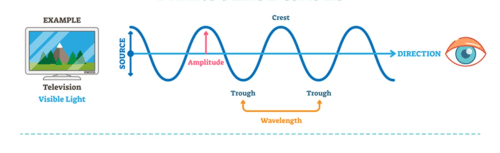
  13. Light Waves
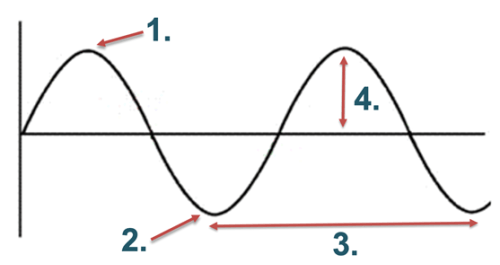
  14. the anatomy of a wave
  15. When the crest of one wave meets the crest of another wave at the same point, increasing the wave's amplitude
    Constructive Interference
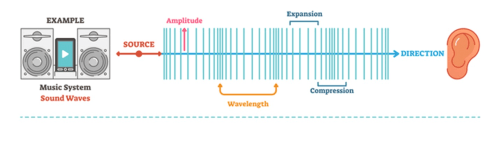
  16. Sound Waves
  17. waves pass through a given point or medium
    Transmission
  18. Electromagnetic waves with wavelengths longer than visible light but shorter than radio waves
    Infared
  19. particle of light
    Photon
  20. Change in the direction of a wave at an interface between two media that sends the wave back into the medium from which it came
    Reflection
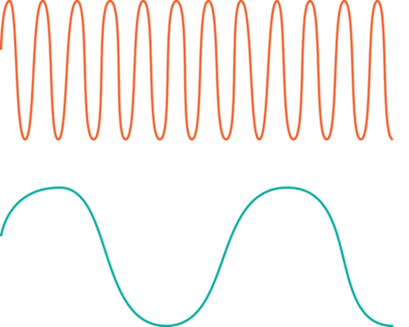
  21. high frequency vs. low frequency
  22. the material through which the wave travels
    Medium
  23. Electromagnetic waves with wavelengths shorter than visible light but longer than X-rays
    UV rays
  24. the highest part of a wave
    Crest