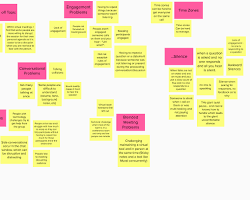
The team getssidetrackedduringbrainstormingand loses focusYou need totranslate userneeds intoactionabledesignrequirementsYou struggleto choose thebest idea topursue afterbrainstormingUsers expresspositivefeedback butsuggest minortweaks to thedesignUsers abandonthe prototypemid-waythrough testingdue tofrustrationYou getstuck on onesolution andcan't seemto move onA usercompletelymisunderstandshow yourprototype worksYou're worriedabout potentialethicalimplicationswhile conductinguser researchYou're stucktrying to definethe coreproblem in onesentence stage?You come upwith an ideaso crazy itmight justworkYou identifyseveral userneeds, butstruggle toprioritize themYou need tobuild aprototypewith limitedresourcesFault inwhichstageYou need tofind a way tomeasure thesuccess of yourproposedsolutionstages?Whichstageof DT?You decide touse cardboardand paperclipsto create yourfirst prototypea lackin whichstage?A usersuggests asurprisingimprovementduring testingWhichstageof DT?You need torecruitparticipants foruser researchon a tightbudgetstage?You observe auser strugglingto complete atask on awebsiteUsers expressdifferent needsandpreferencesduringinterviewsThe team getssidetrackedduringbrainstormingand loses focusYou need totranslate userneeds intoactionabledesignrequirementsYou struggleto choose thebest idea topursue afterbrainstormingUsers expresspositivefeedback butsuggest minortweaks to thedesignUsers abandonthe prototypemid-waythrough testingdue tofrustrationYou getstuck on onesolution andcan't seemto move onA usercompletelymisunderstandshow yourprototype worksYou're worriedabout potentialethicalimplicationswhile conductinguser researchYou're stucktrying to definethe coreproblem in onesentencestage?You come upwith an ideaso crazy itmight justworkYou identifyseveral userneeds, butstruggle toprioritize themYou need tobuild aprototypewith limitedresourcesFault inwhichstageYou need tofind a way tomeasure thesuccess of yourproposedsolutionstages?Whichstageof DT?You decide touse cardboardand paperclipsto create yourfirst prototypea lackin whichstage?A usersuggests asurprisingimprovementduring testingWhichstageof DT?You need torecruitparticipants foruser researchon a tightbudgetstage?You observe auser strugglingto complete atask on awebsiteUsers expressdifferent needsandpreferencesduringinterviews

Design thinking - Call List

(Print) Use this randomly generated list as your call list when playing the game. There is no need to say the BINGO column name. Place some kind of mark (like an X, a checkmark, a dot, tally mark, etc) on each cell as you announce it, to keep track. You can also cut out each item, place them in a bag and pull words from the bag.

1
2
3
4
5
6
7
8
9
10
11
12
13
14
15
16
17
18
19
20
21
22
23
24
25
  1. The team gets sidetracked during brainstorming and loses focus
  2. You need to translate user needs into actionable design requirements
  3. You struggle to choose the best idea to pursue after brainstorming
  4. Users express positive feedback but suggest minor tweaks to the design
  5. Users abandon the prototype mid-way through testing due to frustration
  6. You get stuck on one solution and can't seem to move on
  7. A user completely misunderstands how your prototype works
  8. You're worried about potential ethical implications while conducting user research
  9. You're stuck trying to define the core problem in one sentence
  10. stage?
  11. You come up with an idea so crazy it might just work
  12. You identify several user needs, but struggle to prioritize them
  13. You need to build a prototype with limited resources
  14. Fault in which stage
  15. You need to find a way to measure the success of your proposed solution
  16. stages?
  17. Which stage of DT?
  18. You decide to use cardboard and paperclips to create your first prototype
  19. a lack in which stage?
  20. A user suggests a surprising improvement during testing
  21. Which stage of DT?
  22. You need to recruit participants for user research on a tight budget
  23. stage?
  24. You observe a user struggling to complete a task on a website
  25. Users express different needs and preferences during interviews