(Print) Use this randomly generated list as your call list when playing the game. Place some kind of mark (like an X, a checkmark, a dot, tally mark, etc) on each cell as you announce it, to keep track. You can also cut out each item, place them in a bag and pull words from the bag.
1
2
3
4
5
6
7
8
9
10
11
12
13
14
15
16
17
18
19
20
21
22
23
24
B-Which variable controls how fast the function grows or decays
B-growth/decay factor
(b)
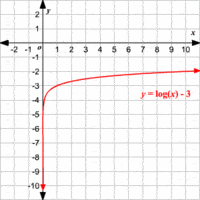
O-What is the range?
O-(-inf, 0)
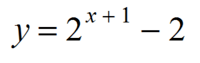
B-What are the transformations?
B-vertical Translation down 2 and Horizontal Translation left 1
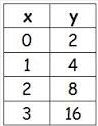
I-Is the table linear, exponential, or neither?
I-exponential
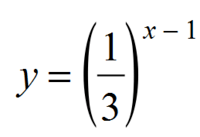
N-Is this an exponetial growth or decay?
N-
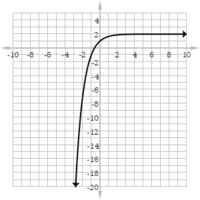
O-What is the horizontail asymptote?
O-y = 2
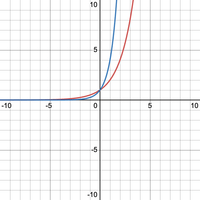
O-Which function grows the fastest?
O-Blue
O-This function has what transformation?
O-Horizontal Translation Right 1
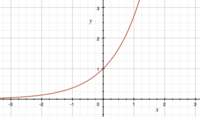
N-What is the Range of the function?
N-y > 1
I-What is the y intercept?
I-(0,1)
G-Two functions are shown in the tables below.
Function A
x y
0 5
1 10
2 20
3 40
Function B
x y
0 4
1 8
2 16
3 32
Based on the tables, which statement about the functions is TRUE?
A. Function A has a greater average rate of change than F
G- Both functions are exponential and have the same growth factor.
G-The standard form of exponential functions.
G-y=a*b^x
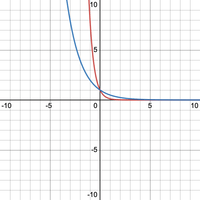
B-Which function decays thye fastest?
B-Red
B-What is the domain of most exponential functions?
B-All Real Numbers
G-What type of function is the following?
f(x)= 3(0.5)^x
G-Exponential Decay
G-What is the asymptote of the following exponential function?
f(x)=4x - 5
G-y= -5
B-What is the graph for y=2^(x) −4
B-
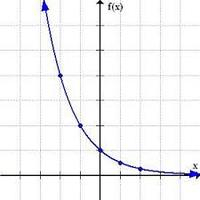
N-Graphs an exponential decay
N-
I-In the function f(x)=9(2)^x
I-9
N-The constant k represents what kind of transformation?
N-Vertical Shift
I-What type of function is this?
I-Linear
G-Compare the following functions:
f(x) = 100(1.25)x
g(x) = 100(1.02)x
Which function has the greater rate of change?
G-f(x)
O-Two functions are defined below.
Exponential Function:
𝑓
(
𝑥
)
=
3
(
1.4
)
𝑥
f(x)=3(1.4)
x
Quadratic Function:
𝑔
(
𝑥
)
=
𝑥
2
−
4
𝑥
+
3
g(x)=x
2
−4x+3
For what values of
𝑥
x are both functions increasing?
O-x > 2
I-The functions f(x)=9(2)^x is what type of exponential function?
I-Exponential Growth