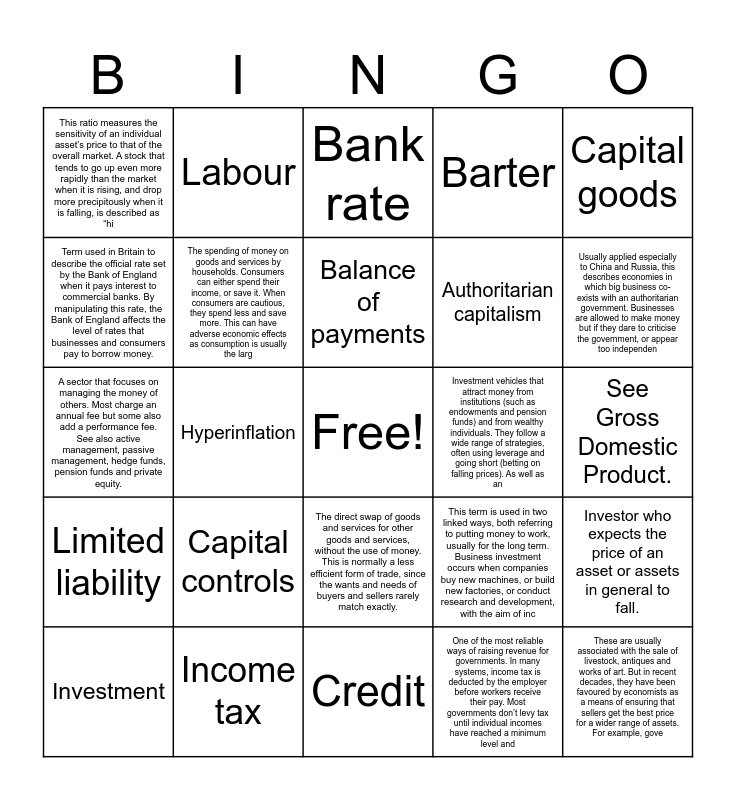
This bingo card has a free space and 50 words: Asset stripping, These are usually associated with the sale of livestock, antiques and works of art. But in recent decades, they have been favoured by economists as a means of ensuring that sellers get the best price for a wider range of assets. For example, gove, Liabilities, Credit, Capital controls, Manufacturing, Labour, Cryptocurrency, Term used in Britain to describe the official rate set by the Bank of England when it pays interest to commercial banks. By manipulating this rate, the Bank of England affects the level of rates that businesses and consumers pay to borrow money., Investment management, The spending of money on goods and services by households. Consumers can either spend their income, or save it. When consumers are cautious, they spend less and save more. This can have adverse economic effects as consumption is usually the larg, Barter, Investor who expects the price of an asset or assets in general to fall., This term is used in two linked ways, both referring to putting money to work, usually for the long term. Business investment occurs when companies buy new machines, or build new factories, or conduct research and development, with the aim of inc, One of the most important concepts in modern capitalism. Limited liability means that investors who own the equity of a company can only lose their initial stake if the business collapses; creditors cannot pursue their other assets, such as thei, The cause that led to the founding of The Economist in 1843. Free-trade enthusiasts believe that the unfettered international exchange of goods and services leads to more efficient economies (see comparative advantage) and thus, in the long run,, Balance of payments, Investment vehicles that attract money from institutions (such as endowments and pension funds) and from wealthy individuals. They follow a wide range of strategies, often using leverage and going short (betting on falling prices). As well as an, GDP, Capital goods, Hyperinflation, One of the most reliable ways of raising revenue for governments. In many systems, income tax is deducted by the employer before workers receive their pay. Most governments don’t levy tax until individual incomes have reached a minimum level and, This ratio measures the sensitivity of an individual asset’s price to that of the overall market. A stock that tends to go up even more rapidly than the market when it is rising, and drop more precipitously when it is falling, is described as “hi, Authoritarian capitalism, The practice of buying a company and rapidly selling off the component parts with the aim of making a profit. This often leads to great disruption in the business and a loss of jobs., Auctions, Usually applied especially to China and Russia, this describes economies in which big business co-exists with an authoritarian government. Businesses are allowed to make money but if they dare to criticise the government, or appear too independen, A term used to describe a country’s transactions with the rest of the world. The import and export of goods and services are captured in the current account, which also includes investment income and transfers (such as expatriate workers sending, Bank rate, The direct swap of goods and services for other goods and services, without the use of money. This is normally a less efficient form of trade, since the wants and needs of buyers and sellers rarely match exactly., Bear, Regulations designed to prevent money from moving across borders. They are often used in regimes with a fixed exchange rate; by preventing money from flowing abroad, they protect the domestic currency from depreciation. Capital controls were a ke, Consumption, When inflation gets out of control—as happened, for example, in Germany in 1923. A loaf of bread cost 200bn marks in November 1923 and workers were paid twice a day because their wages fell in value during the day. Such high rates of inflation ar, Income tax, A catch-all term for the extension of loans to individuals, companies or organisations. The term is also used more generally to refer to the total amount of debt in an economy, as in credit crunch and credit expansion. More narrowly, a credit is, Hedge funds, Beta, The places where money is invested, in the form of short-term loans, bonds, equities and derivatives. Often anthropomorphised in the media (eg, “The markets were unhappy with the government’s budget plans”)., See Gross Domestic Product., Financial markets, Tokens created digitally and at the moment privately, although some central banks have created their own (see this article). Enthusiasts see the currencies as a way of avoiding fiat currency and hence the oversight of governments and banks; owne, Free trade, Physical assets that companies use in the manufacturing process., Investment, A sector that focuses on managing the money of others. Most charge an annual fee but some also add a performance fee. See also active management, passive management, hedge funds, pension funds and private equity., A term used for both a factor for production and for the organised representatives of the working classes (trade unions and some political parties). The supply of labour is an important determinant of economic growth, and the shrinking of the wo, Something owed to others, and the other side of the balance-sheet from assets. Often, this is in the form of money, such as a debt. But it could be a warranty to repair or replace a product that the company has sold or the legal costs involved in, Limited liability and The process of making physical products from raw materials through the use of labour and machinery. Once dominant in developed economies, it now takes a smaller share of GDP than services. That is unlikely to be reversed: see this Explainer..
SPROUT Financial Literacy Bingo | Financial Literacy | Financial Literacy | Economic BINGO | Economic
Share this URL with your players:
For more control of your online game, create a clone of this card first.
Learn how to conduct a bingo game.
With players vying for a you'll have to call about __ items before someone wins. There's a __% chance that a lucky player would win after calling __ items.
Tip: If you want your game to last longer (on average), add more unique words/images to it.