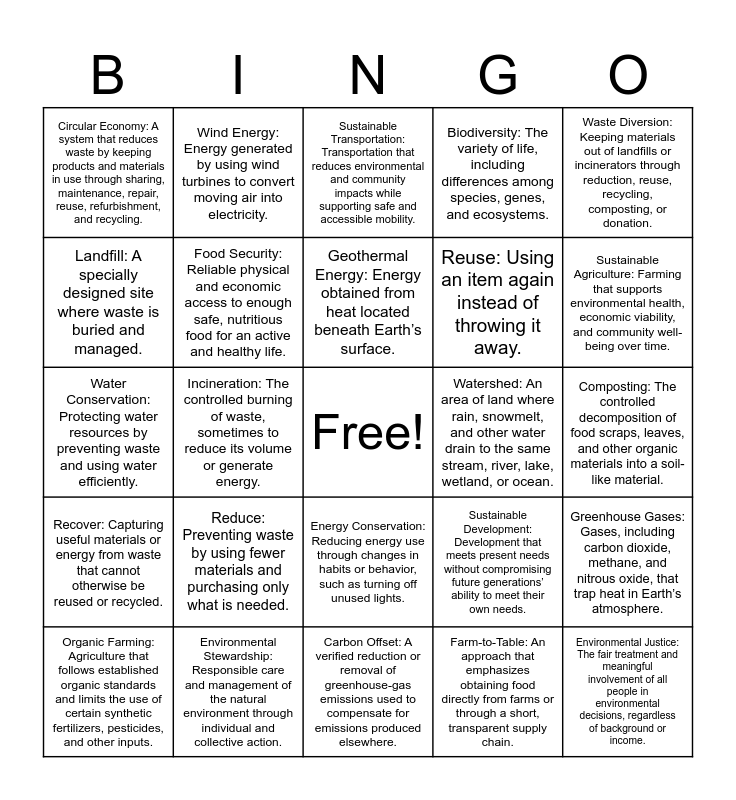
This bingo card has a free space and 64 words: Sustainability: Meeting current needs while protecting environmental, social, and economic resources for future generations., Climate Change: Long-term changes in Earth’s temperatures and weather patterns, increasingly driven by human greenhouse-gas emissions., Carbon Footprint: The total greenhouse-gas emissions associated with a person, organization, activity, event, or product., Greenhouse Gases: Gases, including carbon dioxide, methane, and nitrous oxide, that trap heat in Earth’s atmosphere., Renewable Energy: Energy produced from naturally replenishing sources such as sunlight, wind, water, biomass, and geothermal heat., Solar Energy: Energy from sunlight that can be converted into electricity or heat., Wind Energy: Energy generated by using wind turbines to convert moving air into electricity., Hydropower: Electricity produced by using the movement of water to power turbines., Geothermal Energy: Energy obtained from heat located beneath Earth’s surface., Energy Efficiency: Using less energy to provide the same service or complete the same task., Energy Conservation: Reducing energy use through changes in habits or behavior, such as turning off unused lights., Recycling: Collecting and processing discarded materials so they can be manufactured into new products., Composting: The controlled decomposition of food scraps, leaves, and other organic materials into a soil-like material., Waste Diversion: Keeping materials out of landfills or incinerators through reduction, reuse, recycling, composting, or donation., Zero Waste: A goal of preventing waste by redesigning systems and keeping materials in use for as long as possible., Landfill: A specially designed site where waste is buried and managed., Incineration: The controlled burning of waste, sometimes to reduce its volume or generate energy., Circular Economy: A system that reduces waste by keeping products and materials in use through sharing, maintenance, repair, reuse, refurbishment, and recycling., Upcycling: Transforming a discarded item or material into something of greater value or usefulness., Reuse: Using an item again instead of throwing it away., Reduce: Preventing waste by using fewer materials and purchasing only what is needed., Recover: Capturing useful materials or energy from waste that cannot otherwise be reused or recycled., Biodiversity: The variety of life, including differences among species, genes, and ecosystems., Ecosystem: A community of living organisms interacting with one another and with their physical environment., Habitat: The natural environment where a plant, animal, or other organism lives and obtains what it needs to survive., Conservation: The protection and responsible management of natural resources, habitats, and species., Natural Resources: Materials and features found in nature that people and other living things use, such as water, soil, forests, minerals, and sunlight., Deforestation: The clearing or removal of forests, often to convert the land to another use., Reforestation: Restoring trees to an area that was previously forested but lost its tree cover., Afforestation: Establishing a forest on land that was not recently forested., Native Species: A species that occurs naturally in a particular geographic area., Invasive Species: A nonnative organism that spreads and causes environmental, economic, or human-health harm., Pollinator: An animal, such as a bee, butterfly, bird, or bat, that moves pollen between flowers and helps plants reproduce., Food Waste: Food intended for people that is discarded, spoiled, or left uneaten., Sustainable Agriculture: Farming that supports environmental health, economic viability, and community well-being over time., Organic Farming: Agriculture that follows established organic standards and limits the use of certain synthetic fertilizers, pesticides, and other inputs., Community Garden: A shared space where community members grow fruits, vegetables, herbs, or flowers., Farm-to-Table: An approach that emphasizes obtaining food directly from farms or through a short, transparent supply chain., Local Food: Food produced or processed relatively close to where it is purchased or consumed., Food Security: Reliable physical and economic access to enough safe, nutritious food for an active and healthy life., Water Conservation: Protecting water resources by preventing waste and using water efficiently., Watershed: An area of land where rain, snowmelt, and other water drain to the same stream, river, lake, wetland, or ocean., Stormwater Runoff: Rainwater or melted snow that flows over hard surfaces and land instead of soaking into the ground., Water Quality: The physical, chemical, and biological condition of water, especially in relation to ecosystem health or a particular use., Drought: An extended period of unusually low precipitation that creates a shortage of available water., Environmental Justice: The fair treatment and meaningful involvement of all people in environmental decisions, regardless of background or income., Environmental Stewardship: Responsible care and management of the natural environment through individual and collective action., Resilience: The ability of a person, community, organization, or ecosystem to prepare for, adapt to, and recover from disruptions., Sustainable Development: Development that meets present needs without compromising future generations’ ability to meet their own needs., Triple Bottom Line: A framework that considers social, environmental, and economic outcomes, often described as people, planet, and prosperity or profit., Carbon Neutrality: Balancing the carbon dioxide released with an equivalent amount reduced, removed, or offset., Net Zero: A state in which greenhouse-gas emissions are reduced as much as possible and remaining emissions are balanced by removals., Carbon Offset: A verified reduction or removal of greenhouse-gas emissions used to compensate for emissions produced elsewhere., Carbon Sequestration: The process of capturing and storing carbon in forests, soils, oceans, rocks, or technological systems., Green Building: A building designed, constructed, operated, or renovated to reduce environmental impacts and support occupant well-being., LEED Certification: A green-building rating and certification system that evaluates a building’s sustainability features and performance., Sustainable Transportation: Transportation that reduces environmental and community impacts while supporting safe and accessible mobility., Public Transit: Shared passenger transportation, such as buses, trains, subways, and community shuttles., Active Transportation: Human-powered travel, including walking, bicycling, and using mobility devices., Electric Vehicle: A vehicle powered fully or partly by electricity stored in a battery., Alternative Fuel: A transportation fuel used instead of conventional gasoline or diesel, such as electricity, hydrogen, or certain biofuels., Greenwashing: Using misleading or unsupported environmental claims to make a product, service, or organization appear more sustainable than it is., Life Cycle Assessment: A method for evaluating environmental impacts across a product’s life, from raw-material extraction through production, use, and disposal. and Ecological Footprint: A measure of the biologically productive land and water needed to provide resources and absorb waste associated with a population or activity..
Sustainability Bingo | Energy Resources Bingo | Sustainability | Sustainability Bingo | Sustainability Bingo
Share this URL with your players:
For more control of your online game, create a clone of this card first.
Learn how to conduct a bingo game.
With players vying for a you'll have to call about __ items before someone wins. There's a __% chance that a lucky player would win after calling __ items.
Tip: If you want your game to last longer (on average), add more unique words/images to it.