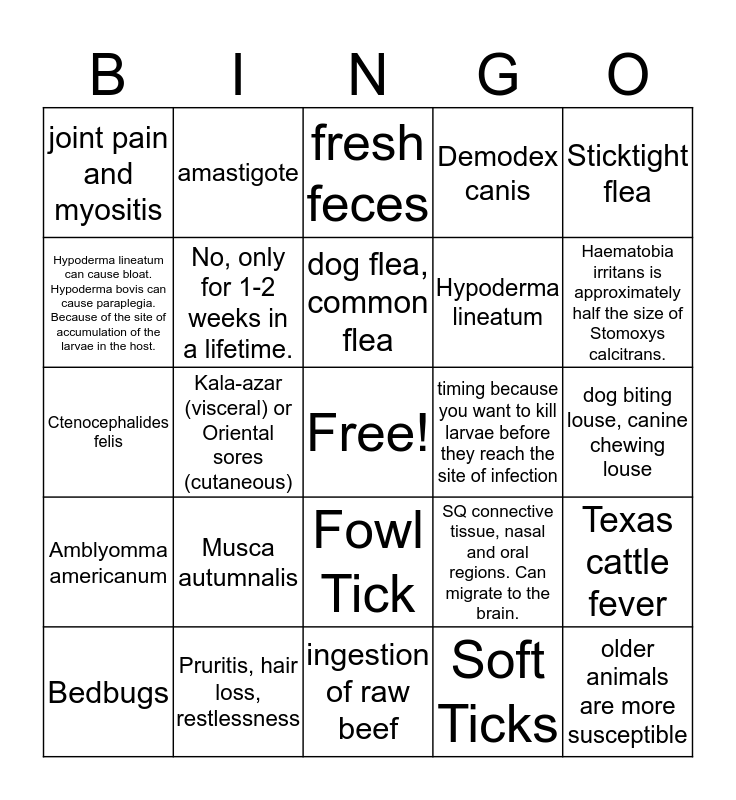
This bingo card has a free space and 269 words: 2nd stage schizogony in vascular endothelium, 3rd stage schizogony in nervous tissue, 70% alcohol, Abortion at 3-9 months, Accumulate in the epidural fat of the spinal cord. Eggs are laid singly., accumulate in the submucosa of the esophagus. Eggs are laid in lines on the lower limbs., All the time, amastigote, amastigotes in macrophages, Amblyomma americanum, Anemia, Anoplocephala perfoliata, Anoplocephala perfoliata/magna, Anoplura are sucking lice with a narrow head that cause anemia. Ischocera are chewing lice with a wide head that cause pruritis., Anoplura spp., around the face, Assasin bug or kissing bug, Babesia bigemina, Babesia canis, Babesia Spp, Back, around horns and belly, Balantidium coli, Bebesia spp, Because females only mate once in a lifetime, Bedbugs, Binary fission, budding or schizogony and sporogony, birds, Biting/chewing lice, can cause pathology in heart muscles --> acute and chronic cardiac disease, Canker and Frounce, cat flea, jumping flea, Cats, cattle biting louse, cattle, herbivores, omnivores, birds, Chew, Cheyletiella yasguri, Chorioptes bovis, Chrysops spp., clinical signs, western blot, PCR, Coccidia, Coccidia, Cochliomyia hominivorax, coitus, Cow feces, Cracks and crevices in cages, Cryptosporidium andersoni, Cryptosporidium hominis, Cryptosporidium parvum, Cryptosporidium spp., Ctenocephalides felis, Culicoides, Cull and Report, Cuterebra spp., the cyst, Cytauxzoon felis, Dark cerumen, decaying hay and other organic matter, deep skin scraping, hair pluck, cytology, Demodex canis, depression, anorexia, anemia and spenomegaly, Dermacentor, Dermanyssus spp., destruction of red blood cells, Destruction of small intestine cells leading to diarrhea, diarrhea, Direct contact with brushes, bedding, etc, Dog biting louse, dog biting louse, canine chewing louse, dog flea, dog flea, common flea, Dogs and cats, Dogs and felids, Dog sucking louse, Drashcia megastoma, habronema spp, Duodenal ulcerations, malabsorption, acute focal inflammation, Duodenum and pylorus, Early abortions, Ear mite, eating undercooked meat, consuming water/food contaminated with cat feces, transplacentally from mother to fetus, Echidnophaga spp., Eggs and Nymphs. Adults do not stay on host., Eimeria, Eimeria leukarti, Eimeria or Coccidia, Eimeria spp., Eimeria tenella, ENNA, ENNNA, enteritis and dysentry, Equine protozoal myeloencephalitis, face fly, Fecal Floatation to detect oocyst, feces and rotting organic matter, Felicola subrostraus, felinds, Feline trichomonas, Fleas, flea saliva, Flesh flies, Floatations or McMaster, Flystrike, Fly worry, Fowl, Fowl. NOT chickens, Fowl Tick, fresh feces, Gamonts in white blood cells, Gasterophilus Intestinalis, Gasterophilus nasalis, Giardia, Giardia intestinalis, Haematobia irritans, Haematobia irritans is approximately half the size of Stomoxys calcitrans., Haematopinous spp., Head, Hepatozoon (americanum), Hepatozoon Spp, Histomonas spp., Histomonas spp, Horn fly, Horse, Horse fly, Hypoderma, Hypoderma lineatum, Hypoderma lineatum can cause bloat. Hypoderma bovis can cause paraplegia. Because of the site of accumulation of the larvae in the host., Hypoderma spp., If lesioned, the parasite can cause a Type I hypersensitivity reaction in the host., Infectious catarrhal enteritis, Infectious enterohepatitis, Infestation of a living animal with diptheran fly larvae. This can be facultative or obligatory., ingestion of raw beef, In GI tract, In muscles, In numbers over 200, Inside sheep nostrils, In sores, wounds, necrotic tissue and soiled wool., Intermandibular area, Intermittent feeders, In the GI tract ( stomach, duodenum), In the tick vector, Ioxodes, Ischnocera louse, Ischnocera spp., Ischnocerca (BITING lice), Isospora, Isospora and Eimeria, Isospora suis, itching, weightloss, reduced egg yield, It has two forms. Histomonas is flagellated in the cecum and pseudopodal in the liver., It is a vector for D. caninum, It is the most pathogenic and causes production losses, It usually infects the eye or lip and does not develop further., Ixoeds, joint pain and myositis, Kala-azar (visceral) or Oriental sores (cutaneous), Keratin digestion, sleeplessness, inappetance, scratching, feather plucking, Keratinization of skin on legs and/or face, Kissing bug, Knemidocoptes spp., Large, robust, beelike, hairy flies with nonfunctional mouthparts. Short lived, obligatory parasites, Larvae and nymphs, Leg, comb, wattle and neck, Leishmania spp., Leucocytozoon spp., Linognathis setosus, listlessness, anemia, labored breathing, CNS symptoms and death, Litte blue cattle louse, livestock, Long nosed cattle louse, malnutrition or chronic disease, margo plicatus and cardiac regions, Melophagus ovinus, Mode of locomotion, Musca autumnalis, Musca domestica, Musca domestica and Musca autumnalis, Nasal passages and sinuses, necropsy, Neospora spp., neurons, New World Screwworm, No, demodex is a normal inhabitant of skin., No, its the aberrant host., None. a single egg hatches inside the female's body at a time., No, only for 1-2 weeks in a lifetime., Northern/Tropical fowl mite, No-see-ums, midges, Notoedric cat mite, occlusion of blood vessels because of infected cell enlargement, Oestridae, Oestrus ovis, older animals are more susceptible, Onchocerca cervicalis, On fresh, uninfected wounds., On hairless areas of the body, lateral elbow and ear pinna, only when feeding at night, opossum, Oral-nasal cavity and upper GI, Ornithonyssus spp., Otodectes Cynotis, oxyuris equi, Paraplegia, PCR or In Pouch TF (culture), pigeon milk, contaminated drinking water and paratenic infection, Pruritis, hair loss, restlessness, Psoroptes, Cheyletiella and Chorioptes, Psoroptes ovis, Psoroptes ovis, rabbits, rodents, raw beef, Red chicken/ Roost mite, night mite, Reduviidae, Reduviid bug, Report it!, Rhipicephalus sanguineus, ruminants and equids, Sucking, Sugar floatation or sedimentation, Swab the ear wax, Swine sucking louse, Tabanus spp., sarcocysts with bradyzoites, Sarcpotes scabiei, Scaly leg/face mite, Screwworm, Setaria equina, Sheep biting louse, Short nosed cattle louse, Skin, feathers, organic material, Slash and sponge, Small and large intestine, small intestine, snotty nose, Soft Ticks, Spinal cord and esophagus, Spinouse ear tick, Sporozoite in sporulated oocyst, Sporulated oocyst, Sporulation, schizogony and gametogony, SQ connective tissue, nasal and oral regions. Can migrate to the brain., Stable fly, Sticktight flea, Stomoxys calcitrans, Tabanus spp., Chrysops spp., Melophagus ovinus, Stomoxys calcitrans and Haematobia irritans, Tachyzoites, Tail head, udder and legs, Texas cattle fever, Theileria, They are obligatory parasites with nonfunctional mouthparts, They feed frequently and usually stay off host (switch hosts)., Tick control, timing because you want to kill larvae before they reach the site of infection, toxoplasma gondii, Toxoplasma gondii and theileria, Transmit protozoans, helminths and viruses. cause pain and can cause allergic reactions in some horses, transplacentally, Trichodectes canis, Trichomonas spp., Trypomastigote in blood, Uninfected wounds, walking dandruff, Warble fly, warm-blooded animals including humans, when in shaded areas, When it is found in cattle, While nursing, White foci on aborted fetuses and placenta, Winter favors proliferation of the lice and You don't!.
⚠ This card has duplicate items: Coccidia (2), Psoroptes ovis (2)
INTRACELLULAR PARASITE BINGO | Let's MRIngo! | Reportable Animal Diseases | Grad Student Bingo | Infection Control
Share this URL with your players:
For more control of your online game, create a clone of this card first.
Learn how to conduct a bingo game.
With players vying for a you'll have to call about __ items before someone wins. There's a __% chance that a lucky player would win after calling __ items.
Tip: If you want your game to last longer (on average), add more unique words/images to it.