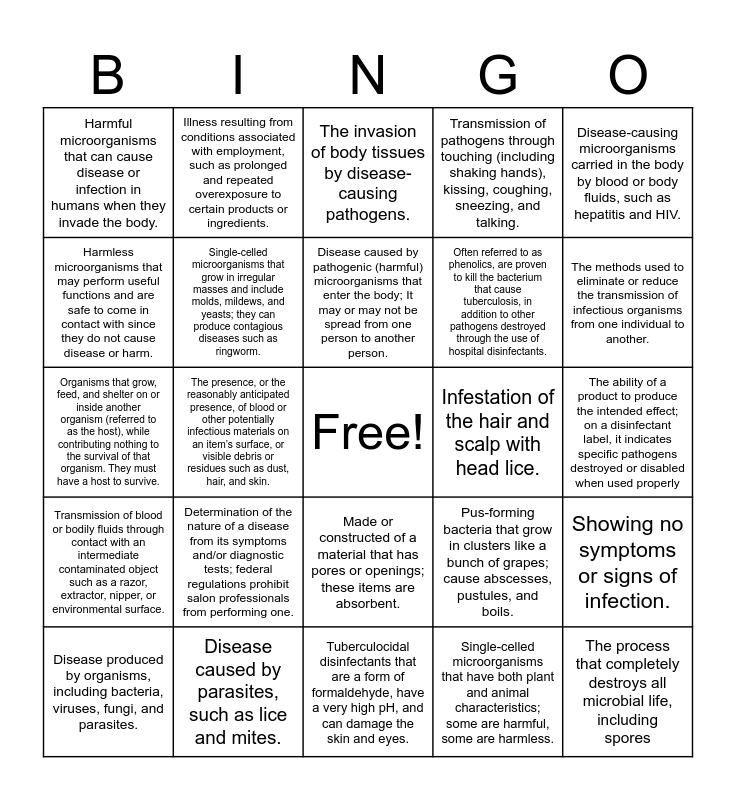
This bingo card has a free space and 24 words: Determination of the nature of a disease from its symptoms and/or diagnostic tests; federal regulations prohibit salon professionals from performing one., Disease caused by parasites, such as lice and mites., Disease caused by pathogenic (harmful) microorganisms that enter the body; It may or may not be spread from one person to another person., Disease produced by organisms, including bacteria, viruses, fungi, and parasites., Disease-causing microorganisms carried in the body by blood or body fluids, such as hepatitis and HIV., Harmful microorganisms that can cause disease or infection in humans when they invade the body., Harmless microorganisms that may perform useful functions and are safe to come in contact with since they do not cause disease or harm., Illness resulting from conditions associated with employment, such as prolonged and repeated overexposure to certain products or ingredients., Infestation of the hair and scalp with head lice., Made or constructed of a material that has pores or openings; these items are absorbent., Often referred to as phenolics, are proven to kill the bacterium that cause tuberculosis, in addition to other pathogens destroyed through the use of hospital disinfectants., Organisms that grow, feed, and shelter on or inside another organism (referred to as the host), while contributing nothing to the survival of that organism. They must have a host to survive., Pus-forming bacteria that grow in clusters like a bunch of grapes; cause abscesses, pustules, and boils., Showing no symptoms or signs of infection., Single-celled microorganisms that grow in irregular masses and include molds, mildews, and yeasts; they can produce contagious diseases such as ringworm., Single-celled microorganisms that have both plant and animal characteristics; some are harmful, some are harmless., The ability of a product to produce the intended effect; on a disinfectant label, it indicates specific pathogens destroyed or disabled when used properly, The invasion of body tissues by disease-causing pathogens., The methods used to eliminate or reduce the transmission of infectious organisms from one individual to another., The presence, or the reasonably anticipated presence, of blood or other potentially infectious materials on an item’s surface, or visible debris or residues such as dust, hair, and skin., The process that completely destroys all microbial life, including spores, Transmission of blood or bodily fluids through contact with an intermediate contaminated object such as a razor, extractor, nipper, or environmental surface., Transmission of pathogens through touching (including shaking hands), kissing, coughing, sneezing, and talking. and Tuberculocidal disinfectants that are a form of formaldehyde, have a very high pH, and can damage the skin and eyes..
Infection Control | Immune Systems | Immune Systems | SALON ECOLOGY G2 | Immune Systems
Share this URL with your players:
For more control of your online game, create a clone of this card first.
Learn how to conduct a bingo game.
With players vying for a you'll have to call about __ items before someone wins. There's a __% chance that a lucky player would win after calling __ items.
Tip: If you want your game to last longer (on average), add more unique words/images to it.