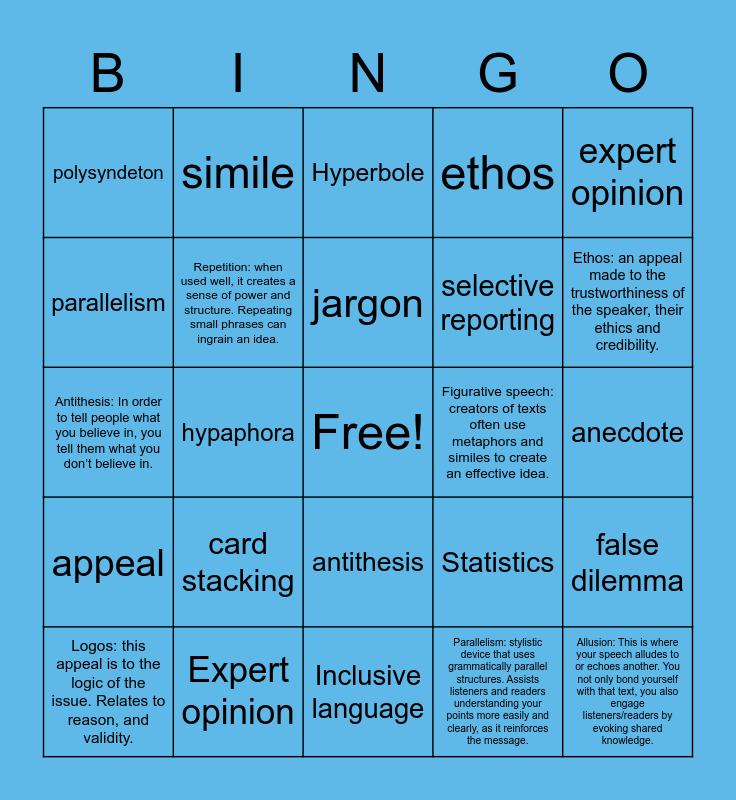
This bingo card has a free space and 63 words: rhetorical question, tricolon, assertion, false dilemma, name calling, repetition, simile, diction, jargon, inclusive language, antithesis, juxtaposition, anecdote, expert opinion, logos, parallelism, hypaphora, polysyndeton, allusion, selective reporting, card stacking, appeal, ethos, pathos, PROPAGANDA TECHNIQUES, Assertion, eg ‘Our Nation is strong’., False dilemma: presenting to an audience a false dilemma, which is simple and binary, where audiences are presented with two extremes, with really no choice., Plain folks: a generalization about the average person and groups., Name calling and pinpointing the enemy: stirs up anger and we see it in 1984; terrorists are called a network of killers, for example. The two-minutes hate is a clear example. Gives the audience a clear sense of right and wrong., Simplification: reducing a complicated situation is a common technique. It manifests itself as stereotypes., Glittering generalities: abstract concepts, such as American justice, civic duty, freedom, democracy, etc, are commonly used to persuade and difficult to oppose., Card stacking: selectively including arguments to support your stance whist ignoring others., RHETORIC, Appeal: there are many appeals, usually to values, in speeches. Traditionally the most common include family, country, loyalty, safety, fear, hip pocket, patriotism etc., Ethos: an appeal made to the trustworthiness of the speaker, their ethics and credibility., Logos: this appeal is to the logic of the issue. Relates to reason, and validity., Pathos: appeals to the emotion within an issue. Think of sympathy, empathy., Parallelism: stylistic device that uses grammatically parallel structures. Assists listeners and readers understanding your points more easily and clearly, as it reinforces the message., Hypophora: common technique where the speaker/ author starts with a question and then answers it., Repetition: when used well, it creates a sense of power and structure. Repeating small phrases can ingrain an idea., Antithesis: In order to tell people what you believe in, you tell them what you don’t believe in., Figurative speech: creators of texts often use metaphors and similes to create an effective idea., Tricolon and polysyndeton: the rule of three, the magic three, the tricolon: it’s all the same thing! The cumulative effect has a powerful effect on an audience. The repetition and use of ‘and’ and other conjunctions creates speed, reinforces the, Juxtaposition: ‘the bitter cold to the scorching heat...’; using things of opposite nature can be very effective in persuading audiences to accept the message., Allusion: This is where your speech alludes to or echoes another. You not only bond yourself with that text, you also engage listeners/readers by evoking shared knowledge., Expert opinion, Anecdote, Statistics, Facts, Selective reporting, Bias, Inclusive language, Exclusive language, Diction, Sarcasm, Hyperbole, Stereotyping, Generalizing, Synecdoche, Euphemisms, Jargon, Cliché and Bandwagoning.
RHETORICAL ANALYSIS | RHETORICAL ANALYSIS | RHETORICAL ANALYSIS BINGO | RHETORICAL ANALYSIS | iPhone Ad Bingo
Share this URL with your players:
For more control of your online game, create a clone of this card first.
Learn how to conduct a bingo game.
With players vying for a you'll have to call about __ items before someone wins. There's a __% chance that a lucky player would win after calling __ items.
Tip: If you want your game to last longer (on average), add more unique words/images to it.