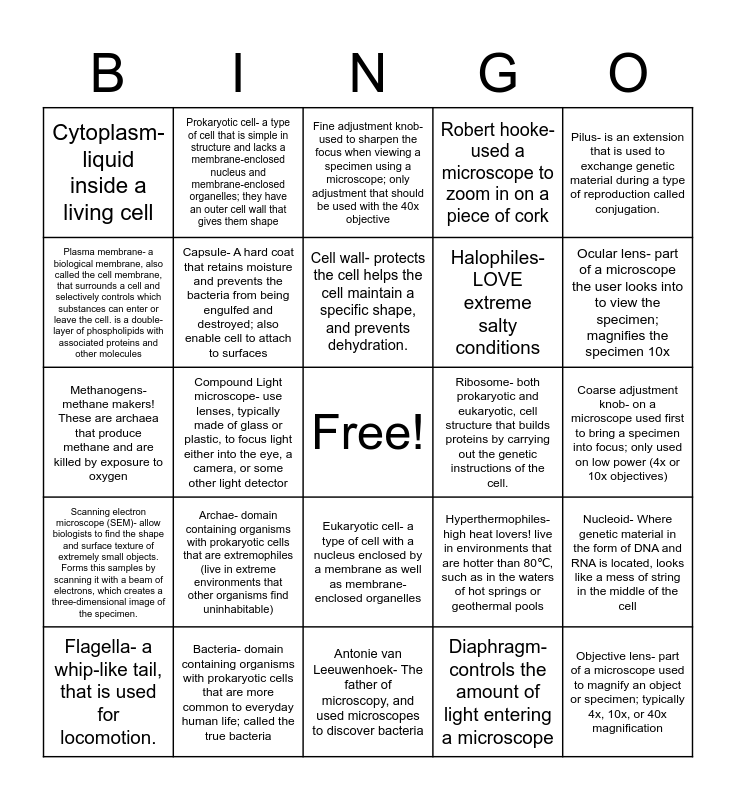
This bingo card has a free space and 24 words: Archae- domain containing organisms with prokaryotic cells that are extremophiles (live in extreme environments that other organisms find uninhabitable), Bacteria- domain containing organisms with prokaryotic cells that are more common to everyday human life; called the true bacteria, Cell wall- protects the cell helps the cell maintain a specific shape, and prevents dehydration., Flagella- a whip-like tail, that is used for locomotion., Pilus- is an extension that is used to exchange genetic material during a type of reproduction called conjugation., Cytoplasm- liquid inside a living cell, Plasma membrane- a biological membrane, also called the cell membrane, that surrounds a cell and selectively controls which substances can enter or leave the cell. is a double-layer of phospholipids with associated proteins and other molecules, Prokaryotic cell- a type of cell that is simple in structure and lacks a membrane-enclosed nucleus and membrane-enclosed organelles; they have an outer cell wall that gives them shape, Ribosome- both prokaryotic and eukaryotic, cell structure that builds proteins by carrying out the genetic instructions of the cell., Eukaryotic cell- a type of cell with a nucleus enclosed by a membrane as well as membrane-enclosed organelles, Halophiles- LOVE extreme salty conditions, Methanogens- methane makers! These are archaea that produce methane and are killed by exposure to oxygen, Hyperthermophiles- high heat lovers! live in environments that are hotter than 80℃, such as in the waters of hot springs or geothermal pools, Nucleoid- Where genetic material in the form of DNA and RNA is located, looks like a mess of string in the middle of the cell, Capsule- A hard coat that retains moisture and prevents the bacteria from being engulfed and destroyed; also enable cell to attach to surfaces, Diaphragm- controls the amount of light entering a microscope, Coarse adjustment knob- on a microscope used first to bring a specimen into focus; only used on low power (4x or 10x objectives), Fine adjustment knob- used to sharpen the focus when viewing a specimen using a microscope; only adjustment that should be used with the 40x objective, Ocular lens- part of a microscope the user looks into to view the specimen; magnifies the specimen 10x, Compound Light microscope- use lenses, typically made of glass or plastic, to focus light either into the eye, a camera, or some other light detector, Objective lens- part of a microscope used to magnify an object or specimen; typically 4x, 10x, or 40x magnification, Scanning electron microscope (SEM)- allow biologists to find the shape and surface texture of extremely small objects. Forms this samples by scanning it with a beam of electrons, which creates a three-dimensional image of the specimen., Robert hooke- used a microscope to zoom in on a piece of cork and Antonie van Leeuwenhoek- The father of microscopy, and used microscopes to discover bacteria.
Domains Bingo | Cell Theory and Cells | Microscope | Microscope BINGO | Microscope BINGO
Share this URL with your players:
For more control of your online game, create a clone of this card first.
Learn how to conduct a bingo game.
With players vying for a you'll have to call about __ items before someone wins. There's a __% chance that a lucky player would win after calling __ items.
Tip: If you want your game to last longer (on average), add more unique words/images to it.