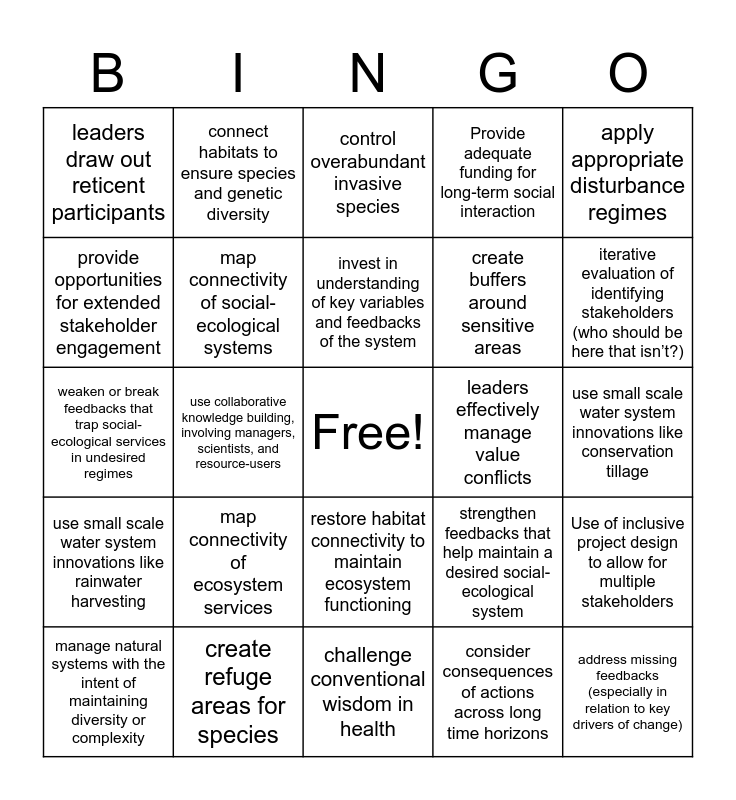
This bingo card has 1 images, a free space and 94 words: consider both formal and informal power structures, use of causal loop diagrams, challenge conventional wisdom in health, challenge conventional wisdom in economics, challenge conventional wisdom in environmental management, challenge gender norms, found a new way of thinking that came from outside the system (expanded worldview), manage natural systems with the intent of maintaining diversity or complexity, monitor species richness, identify keystone species, identify key actors, institutions, or organizations, pay attention to ecosystem services with low redundancy (such as those controlled by keystone species/actors), maintain or create structural complexity in the landscape, create buffers around sensitive areas, maintain landscape heterogeneity, apply appropriate disturbance regimes, control overabundant invasive species, use of agroforestry or organic farming methods, protect native pollinators, reduce fertilizers and pesticides, build green infrastructure, change the focus of management paradigms from efficiency to resilience, provide incentives for livelihood diversity, use broad indicators of well-being beyond jobs or income, map connectivity of ecosystem services, map connectivity of social-ecological systems, use visualization and network analysis tools to map the structure of connectivity, map units flowing across links (information, animals, energy, resources), identify important system elements/ interactions, identify highly connected nodes or isolated patches in the social-ecological system, create refuge areas for species, restore habitat connectivity to maintain ecosystem functioning, purchase land or enact land trusts, manage from a watershed scale, connect habitats to ensure species and genetic diversity, manage current connectivity patterns to contain the risk of a systemic failure, collaborative approach to problem-solving, search for solutions that multi-solve (address several problems at once), invest in understanding of key variables and feedbacks of the system, strengthen feedbacks that help maintain a desired social-ecological system, weaken or break feedbacks that trap social-ecological services in undesired regimes, use small scale water system innovations like rainwater harvesting, use small scale water system innovations like conservation tillage, keep track of actions that obscure or disrupt stabilizing feedbacks, address missing feedbacks (especially in relation to key drivers of change), use of regulation-based feedback, use of incentive-based feedback, use of labeling to connect production system and individual consumers, Direct payments for ecosystem services, monitor slow variables that underlie key thresholds, establish governance structure to respond to changes in slow variables, consider consequences of actions across long time horizons, consider consequences of actions across a range of geographic space, mention of thresholds, tipping points, or the potential for sudden, abrupt change, develop an uncertainty-tolerant culture, use of scenario planning, identify alternative development pathways, assess unintended consequences of decisions, use of system-based frameworks, acknowledge diverse knowledge traditions, use collaborative knowledge building, involving managers, scientists, and resource-users, consider where non-linear change might occur, use of dashboards that account for ecological and social thresholds, use watershed management approach, Use of psychology to change mental models, try experiments or design prototype solutions to see what was effective, If something didn't work, they learned from the experiment and kept trying, support long-term ecological monitoring, provide opportunities for extended stakeholder engagement, Stakeholders engage in prolonged and frequent interaction, Broad and diverse participation represents a range of different sources of knowledge, acknowledge power dynamics, accommodate different levels of literacy, facilitation to share different knowledge, beliefs, and worldviews, Provide adequate funding for long-term social interaction, Use learning networks or communities of practice, clarify goals and expectations of the group through a participatory process, iterative evaluation of identifying stakeholders (who should be here that isn’t?), Use of inclusive project design to allow for multiple stakeholders, consider participant motivation (perceptions of personal benefit, success, or power), reward participation through direct payment or cost recovery, payment to local people for monitoring ecosystem services, leaders show flexibility and adaptive decision-making, leaders effectively manage value conflicts, leaders draw out reticent participants, leaders encouraged participants to question assumptions and positions, leaders encouraged participants to withstand short-term failure, management of power differentials among stakeholders, explicit allotment of financial resources allowing time for learning or failure, consider multiple subjective realities or lived experiences, experiment with different ways to increase engagement, Build social networks to increase trust, government programs share the monitoring of resources and government programs share decision-making with nonprofits or community groups.
Frameworks Bingo | Populations and communities | Ecology | Vocab Binding | 8-1 Living Things and the environment
Share this URL with your players:
For more control of your online game, create a clone of this card first.
Learn how to conduct a bingo game.
With players vying for a you'll have to call about __ items before someone wins. There's a __% chance that a lucky player would win after calling __ items.
Tip: If you want your game to last longer (on average), add more unique words/images to it.