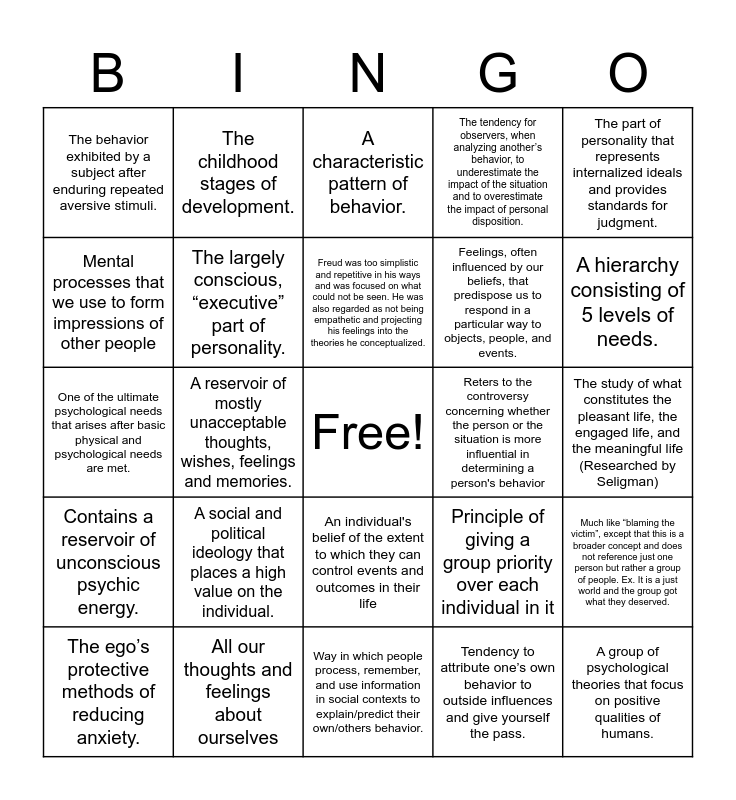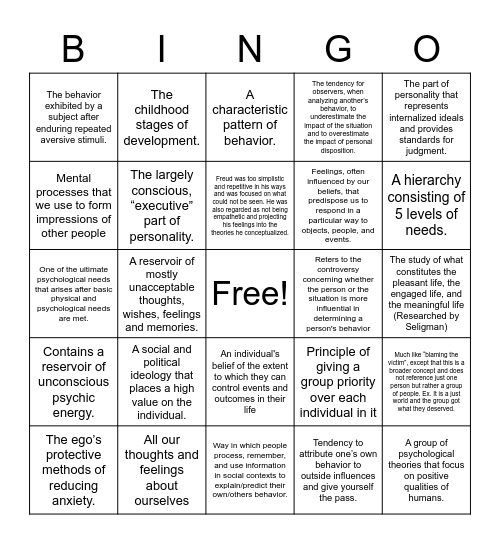
This bingo card has a free space and 33 words: Freud’s theory of personality that attributes thoughts and actions to unconscious motives and conflicts., Famous Neurologist who was the founder of psychoanalysis., A reservoir of mostly unacceptable thoughts, wishes, feelings and memories., Position before consciousness (not currently aware of but could be brought into consciousness at any given moment)., Contains a reservoir of unconscious psychic energy., The largely conscious, “executive” part of personality., The part of personality that represents internalized ideals and provides standards for judgment., The ego’s protective methods of reducing anxiety., The childhood stages of development., A personality test, such as the Rorschach or TAT., Freud was too simplistic and repetitive in his ways and was focused on what could not be seen. He was also regarded as not being empathetic and projecting his feelings into the theories he conceptualized., A characteristic pattern of behavior., Personality Factors. Conscientiousness, Agreeableness, Neuroticism, Openness, Extraversion. (CANOE), A psychological test that assesses personality traits., Reters to the controversy concerning whether the person or the situation is more influential in determining a person's behavior, A hierarchy consisting of 5 levels of needs., All our thoughts and feelings about ourselves, One of the ultimate psychological needs that arises after basic physical and psychological needs are met., A social and political ideology that places a high value on the individual., Principle of giving a group priority over each individual in it, An individual's belief of the extent to which they can control events and outcomes in their life, The theory set forth by psychologist Albert Bandura which states that a person's behavior both influences and is influenced by personal factors and the social environment., The behavior exhibited by a subject after enduring repeated aversive stimuli., The study of what constitutes the pleasant life, the engaged life, and the meaningful life (Researched by Seligman), Way in which people process, remember, and use information in social contexts to explain/predict their own/others behavior., A group of psychological theories that focus on positive qualities of humans., The tendency for observers, when analyzing another’s behavior, to underestimate the impact of the situation and to overestimate the impact of personal disposition., Feelings, often influenced by our beliefs, that predispose us to respond in a particular way to objects, people, and events., Mental processes that we use to form impressions of other people, Much like “blaming the victim”, except that this is a broader concept and does not reference just one person but rather a group of people. Ex. It is a just world and the group got what they deserved., Claim success is from our own efforts and our failures aren’t our faults but due to outside forces beyond our control., Tendency to attribute one’s own behavior to outside influences and give yourself the pass. and The theory that we act to reduce the discomfort we feel when two of our thoughts are inconsistent. For example, when our awareness of our attitudes and of our actions clash, we can reduce the results dissonance by changing our attitudes..
PSYCH BINGO | LOTERIA | Social Psychology Bingo | Exam 3 | T4C
Share this URL with your players:
For more control of your online game, create a clone of this card first.
Learn how to conduct a bingo game.
With players vying for a you'll have to call about __ items before someone wins. There's a __% chance that a lucky player would win after calling __ items.
Tip: If you want your game to last longer (on average), add more unique words/images to it.