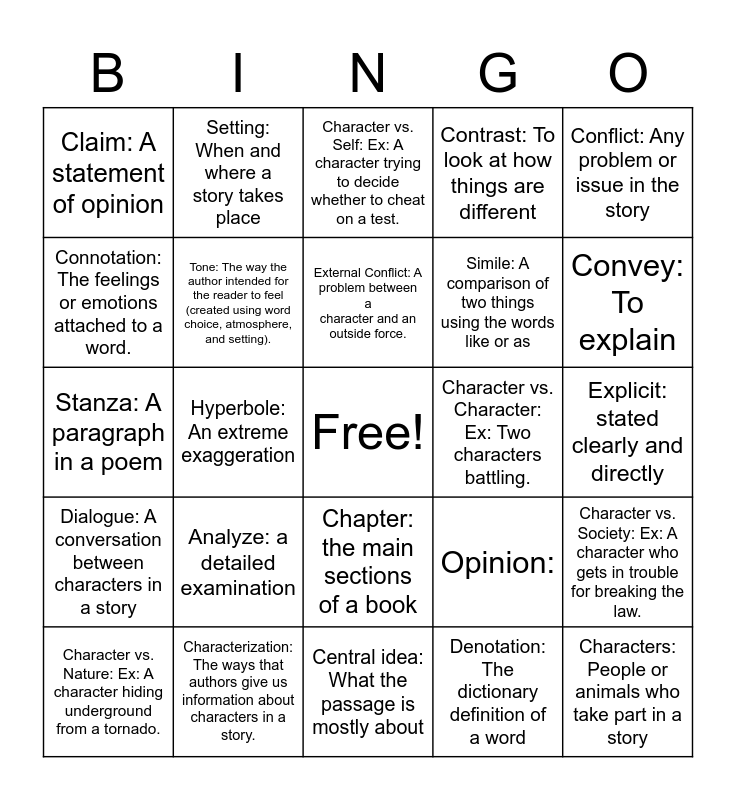
This bingo card has a free space and 59 words: Figurative Language: Language that cannot be taken literally., Characterization: The ways that authors give us information about characters in a story., Author’s Purpose: The reason an author wrote something (Three reasons can be remembered using the acronym PIE), Dialogue: A conversation between characters in a story, Denotation: The dictionary definition of a word, Mood: The way that the reader feels after reading a passage., Tone: The way the author intended for the reader to feel (created using word choice, atmosphere, and setting)., Compare: To look at how things are alike, Simile: A comparison of two things using the words like or as, Metaphor: A comparison of two things by calling the first thing the second thing., Contrast: To look at how things are different, Imagery: Descriptive language that creates a picture in your mind., Connotation: The feelings or emotions attached to a word., Support: To back something up or prove it., Evidence: Proof that supports a claim, Claim: A statement of opinion, Characters: People or animals who take part in a story, Conflict: Any problem or issue in the story, Internal Conflict: A problem that takes place within a character, External Conflict: A problem between a character and an outside force., Character vs. Character: Ex: Two characters battling., Character vs. Self: Ex: A character trying to decide whether to cheat on a test., Character vs. Nature: Ex: A character hiding underground from a tornado., Character vs. Society: Ex: A character who gets in trouble for breaking the law., Flashback: A jump back in time to explain a current event or situation, Foreshadowing: Clues in the story that hint at what is coming next, Point of View: How we see things when reading a story (1st, 2nd, 3rd), Perspective: Who is telling the story and how their opinions/outlook shape the story., Convey: To explain, Conclude: To come to a decision about something, Summary: A description of what a story or article is about---use the 5 w’s to help narrow down information (who, what, when, where, why)., Contribute: To add to something, Plot: Everything that happens in a story, Climax: The turning point in the story, Setting: When and where a story takes place, Theme: The moral or lesson of a story, Personification: When a poet or author gives a non-human thing, human abilities, Hyperbole: An extreme exaggeration, Irony: When the unexpected happens, Stanza: A paragraph in a poem, Alliteration: When the same beginning sound is repeated in a couple of words, Analyze: a detailed examination, Explicit: stated clearly and directly, Inference: using background knowledge and text evidence to make an educated guess, Text: anything you can read or look at for information, Describe: to explain something in words with many details, Drama: a story designed to be presented to an audience by actors; a lot of dialogue; a play, Respond: to say, show, and/or act in response to a question, action, event, claim, or counterclaim, Chapter: the main sections of a book, Central idea: What the passage is mostly about, Event: a thing that happens, Argument:, Evaluate:, Reasons:, Fact:, Opinion:, Context Clues:, Narrator: and Elaborate:.
ELEMENTS OF PLOT | 8th Reading STAAR Vocabulary | LANGUAGE ARTS | Reading STAAR Review | English I
Share this URL with your players:
For more control of your online game, create a clone of this card first.
Learn how to conduct a bingo game.
With players vying for a you'll have to call about __ items before someone wins. There's a __% chance that a lucky player would win after calling __ items.
Tip: If you want your game to last longer (on average), add more unique words/images to it.