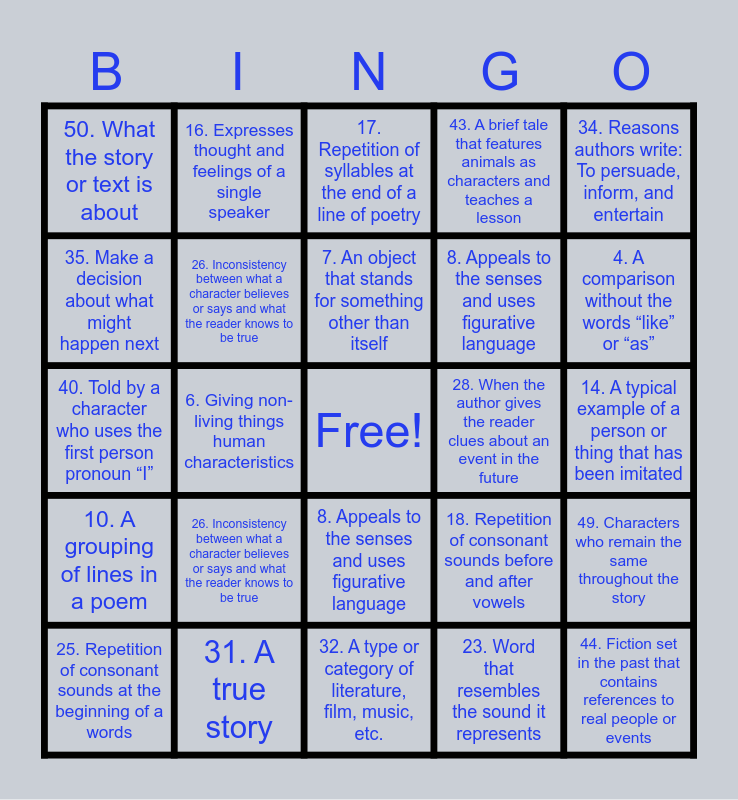
This bingo card has a free space and 94 words: 1. Reference to a well-known place, person, or another work of literature, film, art etc., 2. A comparison using “like” or “as”, 3. The overall lesson the author is trying to teach; central message of work, 4. A comparison without the words “like” or “as”, 5. A series of related metaphors, 6. Giving non-living things human characteristics, 7. An object that stands for something other than itself, 8. Appeals to the senses and uses figurative language, 9. A poem without rhyme or meter, 10. A grouping of lines in a poem, 11. Feelings or ideas associated with a word’s meaning beyond its dictionary meaning, 12. Another word for story, 13. A long poem about a hero or historical event, 14. A typical example of a person or thing that has been imitated, 15. A poem meant to be sung, 16. Expresses thought and feelings of a single speaker, 17. Repetition of syllables at the end of a line of poetry, 18. Repetition of consonant sounds before and after vowels, 19. Inconsistency in what’s expected and what actually happens, 20. When reality is different than what appears to be true, 21. Repetition of vowel sounds in the middle of words, 22. Using sound, syllables, words, or phrases over and over, 23. Word that resembles the sound it represents, 24. When a person says one thing and means the other, 25. Repetition of consonant sounds at the beginning of a words, 26. Inconsistency between what a character believes or says and what the reader knows to be true, 27. Interrupting the story to remember an earlier event, 28. When the author gives the reader clues about an event in the future, 29. A writer’s attitude toward the subject or audience, 30. The atmosphere or emotions a writer creates for the reader, 31. A true story, 32. A type or category of literature, film, music, etc., 33. A type of non-fiction written about someone else, 34. Reasons authors write: To persuade, inform, and entertain, 35. Make a decision about what might happen next, 1. Reference to a well-known place, person, or another work of literature, film, art etc., 2. A comparison using “like” or “as”, 3. The overall lesson the author is trying to teach; central message of work, 4. A comparison without the words “like” or “as”, 5. A series of related metaphors, 6. Giving non-living things human characteristics, 7. An object that stands for something other than itself, 8. Appeals to the senses and uses figurative language, 9. A poem without rhyme or meter, 10. A grouping of lines in a poem, 11. Feelings or ideas associated with a word’s meaning beyond its dictionary meaning, 12. Another word for story, 13. A long poem about a hero or historical event, 14. A typical example of a person or thing that has been imitated, 15. A poem meant to be sung, 16. Expresses thought and feelings of a single speaker, 17. Repetition of syllables at the end of a line of poetry, 18. Repetition of consonant sounds before and after vowels, 19. Inconsistency in what’s expected and what actually happens, 20. When reality is different than what appears to be true, 21. Repetition of vowel sounds in the middle of words, 22. Using sound, syllables, words, or phrases over and over, 23. Word that resembles the sound it represents, 24. When a person says one thing and means the other, 25. Repetition of consonant sounds at the beginning of a words, 26. Inconsistency between what a character believes or says and what the reader knows to be true, 27. Interrupting the story to remember an earlier event, 28. When the author gives the reader clues about an event in the future, 29. A writer’s attitude toward the subject or audience, 30. The atmosphere or emotions a writer creates for the reader, 31. A true story, 32. A type or category of literature, film, music, etc., 33. A type of non-fiction written about someone else, 34. Reasons authors write: To persuade, inform, and entertain, 35. Make a decision about what might happen next, 36. Type of non-fiction where the writer writes about himself, 37. The vantage point from which the story is told, 38. A type of literature that uses imagery, figurative language and special devices, 39. Writing that tells an imaginary story, 40. Told by a character who uses the first person pronoun “I”, 41. Point of view directed at you (instruction manual), 42. Told from a voice outside the action and uses pronouns like he, she, hey, 43. A brief tale that features animals as characters and teaches a lesson, 44. Fiction set in the past that contains references to real people or events, 45. A story that attempts to explain basic questions about the world; usually contains gods and goddesses, 46. The part of story where the characters, setting and situation are introduced, 47. A logical guess based on evidence (clues in the story combined with your experience), 48. A character that changes in a story, especially as a result of an event of problem, 49. Characters who remain the same throughout the story, 50. What the story or text is about, 51. The character or force that opposes the main character, 52. A genre written to be performed by actors on a stage, 53. Prejudice in favor of or against one thing, idea, or person, 54. A character in the story who is known for a single or dominant trait, 55. An extreme exaggeration. Ex. I could eat a horse., 56. The good guy or main/central character in a story, 57. A character in the story who is complex and fully developed, 58. The time and place of the action and 59. An expression that has a meaning different from the meaning of its individual words.
⚠ This card has duplicate items: 1. Reference to a well-known place, person, or another work of literature, film, art etc. (2), 2. A comparison using “like” or “as” (2), 3. The overall lesson the author is trying to teach; central message of work (2), 4. A comparison without the words “like” or “as” (2), 5. A series of related metaphors (2), 6. Giving non-living things human characteristics (2), 7. An object that stands for something other than itself (2), 8. Appeals to the senses and uses figurative language (2), 9. A poem without rhyme or meter (2), 10. A grouping of lines in a poem (2), 11. Feelings or ideas associated with a word’s meaning beyond its dictionary meaning (2), 12. Another word for story (2), 13. A long poem about a hero or historical event (2), 14. A typical example of a person or thing that has been imitated (2), 15. A poem meant to be sung (2), 16. Expresses thought and feelings of a single speaker (2), 17. Repetition of syllables at the end of a line of poetry (2), 18. Repetition of consonant sounds before and after vowels (2), 19. Inconsistency in what’s expected and what actually happens (2), 20. When reality is different than what appears to be true (2), 21. Repetition of vowel sounds in the middle of words (2), 22. Using sound, syllables, words, or phrases over and over (2), 23. Word that resembles the sound it represents (2), 24. When a person says one thing and means the other (2), 25. Repetition of consonant sounds at the beginning of a words (2), 26. Inconsistency between what a character believes or says and what the reader knows to be true (2), 27. Interrupting the story to remember an earlier event (2), 28. When the author gives the reader clues about an event in the future (2), 29. A writer’s attitude toward the subject or audience (2), 30. The atmosphere or emotions a writer creates for the reader (2), 31. A true story (2), 32. A type or category of literature, film, music, etc. (2), 33. A type of non-fiction written about someone else (2), 34. Reasons authors write: To persuade, inform, and entertain (2), 35. Make a decision about what might happen next (2)
Reading Vocabulary Bingo Blue | Reading Vocabulary Bingo Blue | Literary Devices and Elements | Literary Terms | Literary Terms
Share this URL with your players:
For more control of your online game, create a clone of this card first.
Learn how to conduct a bingo game.
With players vying for a you'll have to call about __ items before someone wins. There's a __% chance that a lucky player would win after calling __ items.
Tip: If you want your game to last longer (on average), add more unique words/images to it.