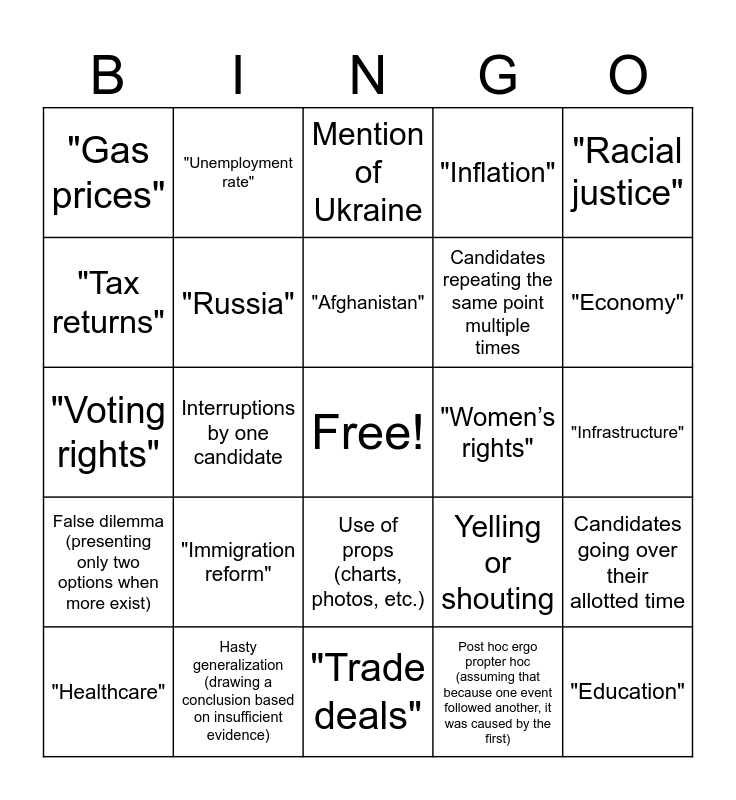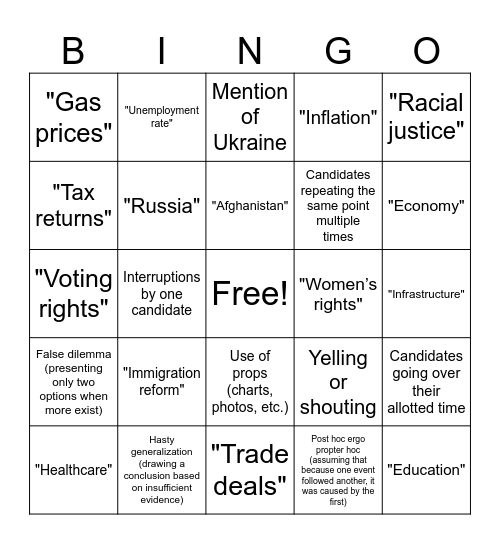
This bingo card has a free space and 80 words: "Make America Great Again", "Build Back Better", Mention of Ukraine, Mention of Hunter Biden, Reference to the border wall, "Sleepy Joe", "Fake News", "Climate Change", "COVID-19 pandemic", "Election fraud", "Second Amendment", "Supreme Court", "Inflation", "Gas prices", "China", "Tax returns", "Obamacare", "Immigration reform", "Middle class", "Infrastructure", "Law and order", "Racial justice", "Voting rights", "Afghanistan", "Russia", "Green New Deal", "Social Security", "Medicare", "Veterans", "Police reform", "Economy", "Jobs", "Trade deals", "Bipartisanship", "Healthcare", "Women’s rights", "Gun control", "Abortion", "LGBTQ+ rights", "Education", "Student loans", "Infrastructure bill", "National security", "Cybersecurity", "Clean energy", "Unemployment rate", "Mental health", "Affordable housing", "Foreign policy", "Minimum wage", Candidates going over their allotted time, Interruptions by one candidate, Yelling or shouting, Moderator having to step in, Moderator muting a candidate's microphone, Candidates talking over each other, Personal attacks or name-calling, Awkward pauses, Candidates avoiding answering the question directly, Use of props (charts, photos, etc.), Candidates repeating the same point multiple times, Crowd reactions (cheering, booing, etc.), Candidates making jokes or sarcastic remarks, Technical difficulties, Candidates using rehearsed one-liners or catchphrases, Ad hominem (attacking the opponent instead of their argument), Strawman (misrepresenting the opponent's argument to make it easier to attack), Slippery slope (arguing that one action will lead to a series of negative events), Red herring (distracting from the main issue with an irrelevant point), Appeal to emotion (using emotions rather than facts to persuade), False dilemma (presenting only two options when more exist), Hasty generalization (drawing a conclusion based on insufficient evidence), Circular reasoning (the argument's conclusion is used as a premise), Bandwagon (arguing that something is true because it is popular), Appeal to authority (using the opinion of an authority figure as evidence), Begging the question (assuming the truth of what one is supposed to prove), Post hoc ergo propter hoc (assuming that because one event followed another, it was caused by the first), Non sequitur (a conclusion that doesn't logically follow from the premises), Appeal to tradition (arguing that something should continue because it has traditionally been done that way) and Loaded question (asking a question that contains a presupposition).
Persuasive Techniques and Fallacies | Fallacies | Fallacy Bingo | Logical Fallacy Bingo | the fallacy game!
Share this URL with your players:
For more control of your online game, create a clone of this card first.
Learn how to conduct a bingo game.
With players vying for a you'll have to call about __ items before someone wins. There's a __% chance that a lucky player would win after calling __ items.
Tip: If you want your game to last longer (on average), add more unique words/images to it.