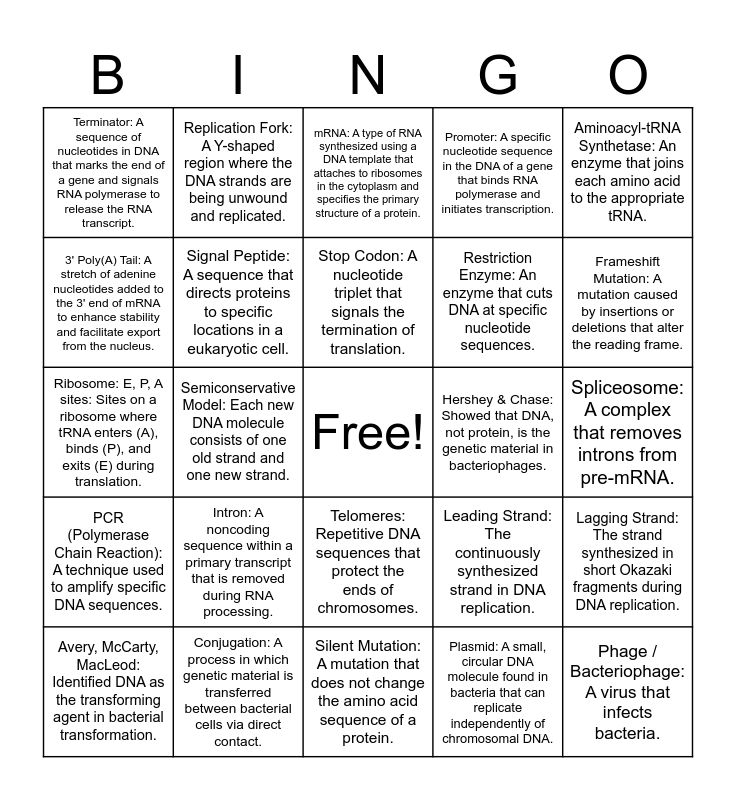
This bingo card has a free space and 81 words: Transcription: The synthesis of RNA using a DNA template., Translation: The synthesis of a polypeptide using the genetic information encoded in an mRNA molecule., mRNA: A type of RNA synthesized using a DNA template that attaches to ribosomes in the cytoplasm and specifies the primary structure of a protein., tRNA: An RNA molecule that functions as a translator between nucleic acid and protein languages by carrying specific amino acids to the ribosome., rRNA: RNA molecules that, together with proteins, make up ribosomes; the most abundant type of RNA., RNA Processing: Modification of RNA primary transcripts, including splicing out of introns, joining exons, and altering the 5' and 3' ends., Triplet Code: A genetic information system in which a set of three-nucleotide-long words specify the amino acids for polypeptide chains., Template Strand: The DNA strand that provides the pattern for ordering nucleotides in an RNA transcript., Codon: A three-nucleotide sequence of DNA or mRNA that specifies a particular amino acid or termination signal., Anticodon: A nucleotide triplet at one end of a tRNA molecule that base-pairs with a codon on an mRNA molecule., Reading Frame: On an mRNA, the triplet grouping of ribonucleotides used by the translation machinery during polypeptide synthesis., RNA Polymerase: An enzyme that links ribonucleotides into a growing RNA chain during transcription., Promoter: A specific nucleotide sequence in the DNA of a gene that binds RNA polymerase and initiates transcription., Terminator: A sequence of nucleotides in DNA that marks the end of a gene and signals RNA polymerase to release the RNA transcript., 5' cap: A modified guanine nucleotide added to the 5' end of mRNA to protect it from degradation and facilitate ribosome binding., 3' Poly(A) Tail: A stretch of adenine nucleotides added to the 3' end of mRNA to enhance stability and facilitate export from the nucleus., RNA Splicing: The removal of introns and joining of exons in an mRNA molecule., Intron: A noncoding sequence within a primary transcript that is removed during RNA processing., Exon: A coding sequence that remains in the RNA after RNA processing., Spliceosome: A complex that removes introns from pre-mRNA., Ribozyme: An RNA molecule that functions as an enzyme, such as an intron that catalyzes its own removal during RNA splicing., Aminoacyl-tRNA Synthetase: An enzyme that joins each amino acid to the appropriate tRNA., Ribosome: E, P, A sites: Sites on a ribosome where tRNA enters (A), binds (P), and exits (E) during translation., Stop Codon: A nucleotide triplet that signals the termination of translation., Signal Peptide: A sequence that directs proteins to specific locations in a eukaryotic cell., Mutation: A change in the nucleotide sequence of an organism's DNA., Point Mutation: A change in a single nucleotide pair of a gene., Base-Pair Substitution: A mutation where one base pair is replaced by another., Insertion: A mutation involving the addition of one or more nucleotide pairs to a gene., Deletion: A mutation involving the loss of one or more nucleotide pairs from a gene., Frameshift Mutation: A mutation caused by insertions or deletions that alter the reading frame., Mutagen: A chemical or physical agent that causes mutations., Silent Mutation: A mutation that does not change the amino acid sequence of a protein., Griffith Experiment: Discovered bacterial transformation by injecting mice with different strains of bacteria., Avery, McCarty, MacLeod: Identified DNA as the transforming agent in bacterial transformation., Hershey & Chase: Showed that DNA, not protein, is the genetic material in bacteriophages., Chargaff: Discovered that DNA has equal amounts of A-T and G-C base pairs., Rosalind Franklin & Maurice Wilkins: Used X-ray diffraction to determine the helical structure of DNA., Watson & Crick: Built the first accurate model of the DNA double helix., Transformation: The assimilation of external DNA by a cell, resulting in a genetic change., Phage / Bacteriophage: A virus that infects bacteria., Double Helix: The two-stranded spiral structure of DNA., Purine: A nitrogenous base with a double-ring structure (adenine and guanine)., Pyrimidine: A nitrogenous base with a single-ring structure (cytosine, thymine, and uracil)., Semiconservative Model: Each new DNA molecule consists of one old strand and one new strand., Origin of Replication: The specific site where DNA replication begins., Replication Fork: A Y-shaped region where the DNA strands are being unwound and replicated., DNA Polymerase: An enzyme that adds nucleotides to a growing DNA strand., Antiparallel: The opposite orientation of DNA strands in the double helix., 5' and 3' Ends: The directionality of DNA strands; nucleotides are added to the 3' end., Leading Strand: The continuously synthesized strand in DNA replication., Lagging Strand: The strand synthesized in short Okazaki fragments during DNA replication., Okazaki Fragments: Short DNA fragments formed on the lagging strand., DNA Ligase: An enzyme that joins Okazaki fragments by forming covalent bonds., Primer: A short RNA sequence that provides a starting point for DNA synthesis., Primase: An enzyme that synthesizes RNA primers., Helicase: An enzyme that unwinds the DNA double helix., Single-Strand Binding Protein: Proteins that stabilize single-stranded DNA during replication., Nuclease: An enzyme that removes damaged DNA segments., Nucleotide Excision Repair: A DNA repair process that removes and replaces damaged nucleotides., Telomeres: Repetitive DNA sequences that protect the ends of chromosomes., Telomerase: An enzyme that extends telomeres to prevent chromosome shortening., Operon: A genetic unit consisting of a promoter, operator, and genes regulated together., Operator: A DNA segment that acts as a switch for transcription regulation., Repressor: A protein that inhibits gene transcription by binding to the operator., Regulatory Gene: A gene that codes for proteins controlling the expression of other genes., Corepressor: A molecule that helps a repressor turn off transcription., Inducer: A molecule that inactivates a repressor, turning on gene transcription., Lac Operon: An inducible operon in bacteria that controls the metabolism of lactose., Trp Operon: A repressible operon in bacteria that regulates the production of tryptophan., Gel Electrophoresis: A technique used to separate DNA fragments based on size using an electric field., PCR (Polymerase Chain Reaction): A technique used to amplify specific DNA sequences., Conjugation: A process in which genetic material is transferred between bacterial cells via direct contact., Apoptosis: A programmed cell death process that eliminates damaged or unnecessary cells., Topoisomerase: An enzyme that prevents the over-winding of DNA ahead of the replication fork by breaking, swiveling, and rejoining DNA strands., Ribosome: A molecular machine that synthesizes proteins by translating mRNA., rRNA (Ribosomal RNA): A type of RNA that, along with proteins, forms the structure of ribosomes and catalyzes protein synthesis., Plasmid: A small, circular DNA molecule found in bacteria that can replicate independently of chromosomal DNA., Chaperone Protein: A protein that assists in the folding and assembly of other proteins., Restriction Enzyme: An enzyme that cuts DNA at specific nucleotide sequences. and Transposition: The movement of a DNA segment from one location to another within the genome..
DNA Bingo | DNA Terms | Chapters 11-14 | DNA bingo!! | AP Bio Unit 6 Vocabulary
Share this URL with your players:
For more control of your online game, create a clone of this card first.
Learn how to conduct a bingo game.
With players vying for a you'll have to call about __ items before someone wins. There's a __% chance that a lucky player would win after calling __ items.
Tip: If you want your game to last longer (on average), add more unique words/images to it.