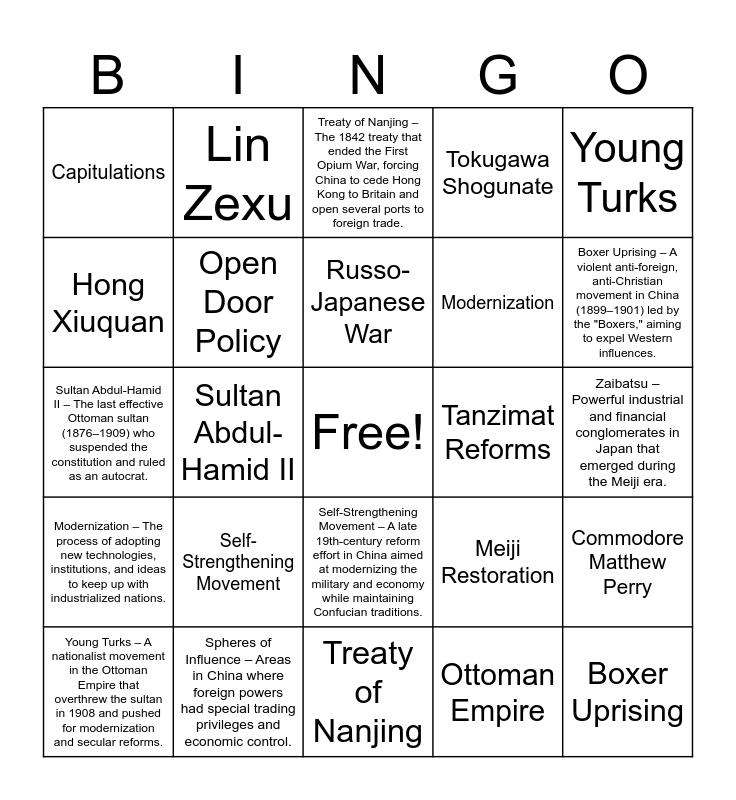
This bingo card has a free space and 50 words: Taiping Rebellion, Boxer Uprising, Opium Wars, Treaty of Nanjing, Self-Strengthening Movement, Empress Dowager Cixi, Lin Zexu, Unequal Treaties, Hong Xiuquan, Spheres of Influence, Open Door Policy, Tokugawa Shogunate, Commodore Matthew Perry, Meiji Restoration, Zaibatsu, Sino-Japanese War, Russo-Japanese War, Tanzimat Reforms, Young Ottomans, Young Turks, Sultan Abdul-Hamid II, Ottoman Empire, Capitulations, Modernization, Westernization, Taiping Rebellion – A massive Chinese rebellion (1850–1864) led by Hong Xiuquan, who claimed to be the brother of Jesus, advocating radical social reforms and challenging Qing rule., Boxer Uprising – A violent anti-foreign, anti-Christian movement in China (1899–1901) led by the "Boxers," aiming to expel Western influences., Opium Wars – Two wars (1839–1842, 1856–1860) between Britain and China over opium trade disputes, ending in China’s defeat and humiliating treaties., Treaty of Nanjing – The 1842 treaty that ended the First Opium War, forcing China to cede Hong Kong to Britain and open several ports to foreign trade., Self-Strengthening Movement – A late 19th-century reform effort in China aimed at modernizing the military and economy while maintaining Confucian traditions., Empress Dowager Cixi – A powerful conservative ruler of China (1861–1908) who resisted major reforms and supported the Boxer Uprising., Lin Zexu – A Chinese official who aggressively opposed the opium trade, leading to the First Opium War., Unequal Treaties – A series of treaties imposed on China by Western powers, granting foreigners special privileges and weakening Chinese sovereignty., Hong Xiuquan – Leader of the Taiping Rebellion, who claimed to be the younger brother of Jesus and sought to create a utopian Christian society., Spheres of Influence – Areas in China where foreign powers had special trading privileges and economic control., Open Door Policy – A U.S.-proposed policy (1899) that aimed to keep China open to trade with all nations rather than being divided by European powers., Tokugawa Shogunate – The military government of Japan (1603–1868) that followed a policy of isolation until it was overthrown by the Meiji Restoration., Commodore Matthew Perry – The U.S. naval officer who forced Japan to open its ports to trade in 1853 through gunboat diplomacy., Meiji Restoration – The rapid modernization and industrialization of Japan (1868–1912) under Emperor Meiji, replacing the feudal shogunate with a centralized government., Zaibatsu – Powerful industrial and financial conglomerates in Japan that emerged during the Meiji era., Sino-Japanese War – A war (1894–1895) between China and Japan, resulting in Japan’s victory and its dominance over Korea and Taiwan., Russo-Japanese War – A war (1904–1905) in which Japan defeated Russia, marking the first time an Asian power defeated a European empire., Tanzimat Reforms – A series of reforms (1839–1876) in the Ottoman Empire aimed at modernizing the military, government, and legal system., Young Ottomans – A group of reformers in the Ottoman Empire who sought a constitutional government blending Islamic and Western principles., Young Turks – A nationalist movement in the Ottoman Empire that overthrew the sultan in 1908 and pushed for modernization and secular reforms., Sultan Abdul-Hamid II – The last effective Ottoman sultan (1876–1909) who suspended the constitution and ruled as an autocrat., Ottoman Empire – A declining Islamic empire that struggled with internal challenges and external threats in the 19th century., Capitulations – Agreements that gave European powers legal and economic privileges in the Ottoman Empire, weakening its sovereignty., Modernization – The process of adopting new technologies, institutions, and ideas to keep up with industrialized nations. and Westernization – The adoption of Western culture, ideas, and institutions, often in response to external pressures..
Modern World History Q2 Review Bingo | Modern World History Q2 Review Bingo | Origins of the Modern World and Imperialism | Imperialism Review | Imperialism
Share this URL with your players:
For more control of your online game, create a clone of this card first.
Learn how to conduct a bingo game.
With players vying for a you'll have to call about __ items before someone wins. There's a __% chance that a lucky player would win after calling __ items.
Tip: If you want your game to last longer (on average), add more unique words/images to it.