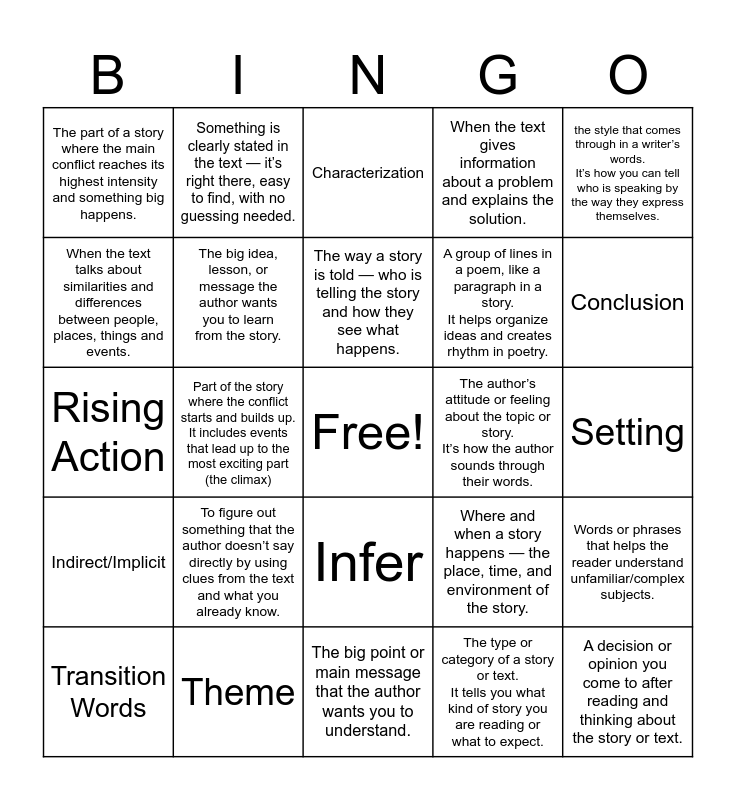
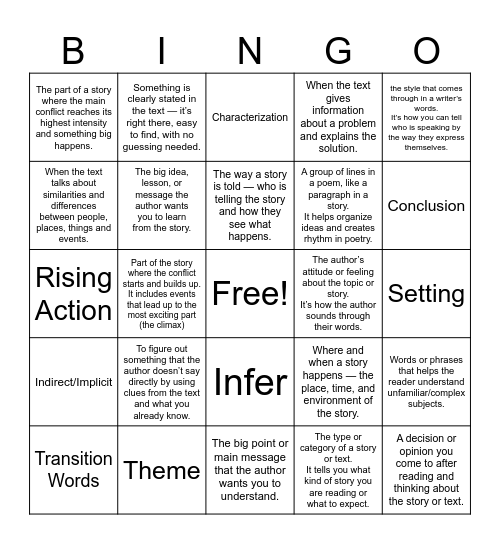
This bingo card has a free space and 48 words: Main idea or point of an essay or story., A decision or opinion you come to after reading and thinking about the story or text., Words or phrases that connect ideas and help your writing flow smoothly., The big point or main message that the author wants you to understand., To figure out something that the author doesn’t say directly by using clues from the text and what you already know., Something is not stated clearly or directly — you have to figure it out using clues., Something is clearly stated in the text — it’s right there, easy to find, with no guessing needed., The feeling or atmosphere that a reader gets from a story or text. (How the author wants you to feel while you read.), When the text talks about similarities and differences between people, places, things and events., When the text describes an effect (Cause) and the effects that follow., The big idea, lesson, or message the author wants you to learn from the story., When the text gives information about a problem and explains the solution., Words or phrases that helps the reader understand unfamiliar/complex subjects., Where and when a story happens — the place, time, and environment of the story., The moment in a story when the main problem/conflict reaches its most intense point and the story starts to change direction., a short retelling of the most important parts of a story . (what happened but leaves out small details and opinions.), The way a story is told — who is telling the story and how they see what happens., The author’s attitude or feeling about the topic or story. It’s how the author sounds through their words., How the author shows what characters are like (direct or indirect), the style that comes through in a writer’s words. It’s how you can tell who is speaking by the way they express themselves., Part of the story where the conflict starts and builds up. It includes events that lead up to the most exciting part (the climax), The type or category of a story or text. It tells you what kind of story you are reading or what to expect., The part of a story where the main conflict reaches its highest intensity and something big happens., A group of lines in a poem, like a paragraph in a story. It helps organize ideas and creates rhythm in poetry., Thesis, Conclusion, Transition Words, Main Idea/ Central Idea, Infer, Indirect/Implicit, Direct/Explicit, Mood, Compare/Contrast, Cause/Effect, Theme, Problem and solution, Vocabulary Words, Setting, Turning point, Summary, Point of view, Tone (Sound), Characterization, Voice (Who), Rising Action, Genre, Climax and Stanza.
Reading STAAR Review | Grade 3 - NYS ELA Vocabulary | Grade 3 - NYS ELA Vocabulary | Grade 3 - NYS ELA Vocabulary | Grade 3 - NYS ELA Vocabulary
Share this URL with your players:
For more control of your online game, create a clone of this card first.
Learn how to conduct a bingo game.
With players vying for a you'll have to call about __ items before someone wins. There's a __% chance that a lucky player would win after calling __ items.
Tip: If you want your game to last longer (on average), add more unique words/images to it.