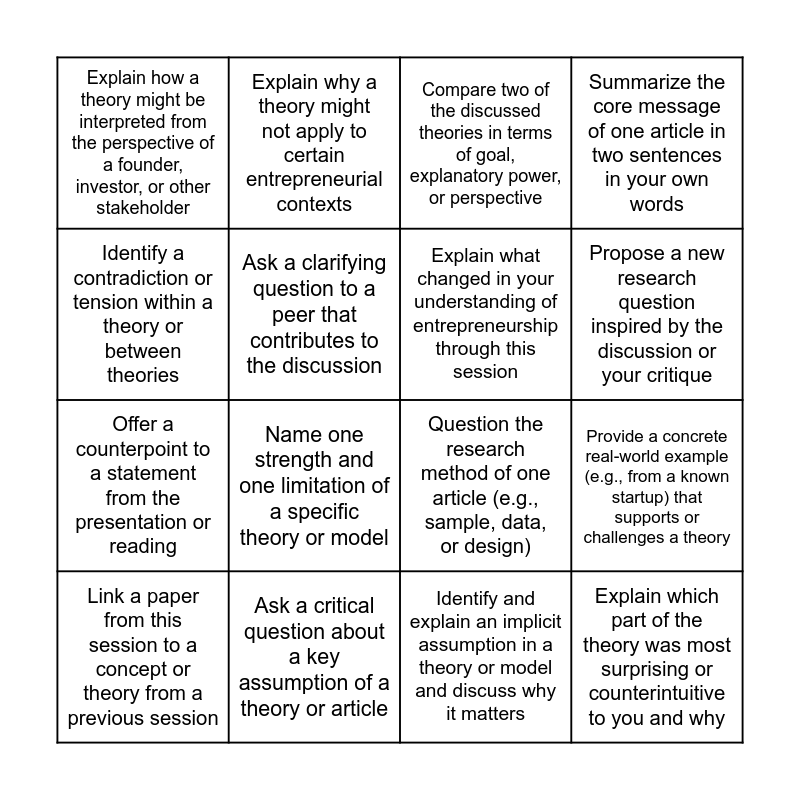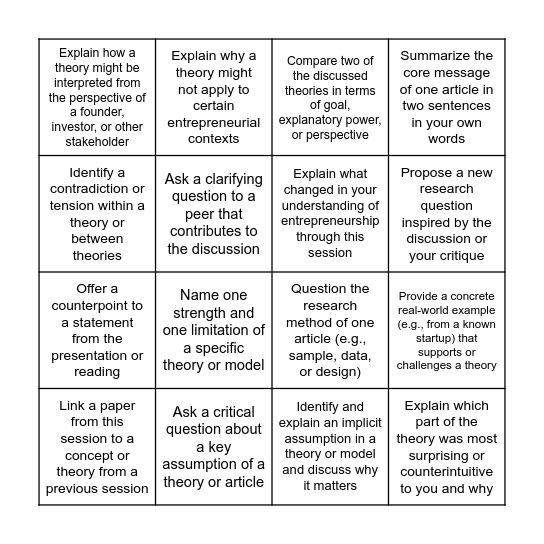
This bingo card has 16 words: Ask a critical question about a key assumption of a theory or article, Provide a concrete real-world example (e.g., from a known startup) that supports or challenges a theory, Compare two of the discussed theories in terms of goal, explanatory power, or perspective, Explain how a theory might be interpreted from the perspective of a founder, investor, or other stakeholder, Offer a counterpoint to a statement from the presentation or reading, Explain why a theory might not apply to certain entrepreneurial contexts, Question the research method of one article (e.g., sample, data, or design), Identify and explain an implicit assumption in a theory or model and discuss why it matters, Identify a contradiction or tension within a theory or between theories, Ask a clarifying question to a peer that contributes to the discussion, Link a paper from this session to a concept or theory from a previous session, Summarize the core message of one article in two sentences in your own words, Name one strength and one limitation of a specific theory or model, Propose a new research question inspired by the discussion or your critique, Explain what changed in your understanding of entrepreneurship through this session and Explain which part of the theory was most surprising or counterintuitive to you and why.
Discussion Bingo | Product PI Planning | MKT 802 Bingo | MKT 802 Bingo | MKT 802 Bingo
Share this URL with your players:
For more control of your online game, create a clone of this card first.
Learn how to conduct a bingo game.
With players vying for a you'll have to call about __ items before someone wins. There's a __% chance that a lucky player would win after calling __ items.
Tip: If you want your game to last longer (on average), add more unique words/images to it.